Start Here — The Three Quick Checks
I found a $100 bill in my grandfather’s desk last year and immediately Googled whether old money was worth anything. Turns out, I was holding something worth closer to $400. Here’s what I wish I’d known first — most old $100 bills are worth exactly $100. Some are worth significantly more. The difference comes down to three observable features you can check right now without special equipment.
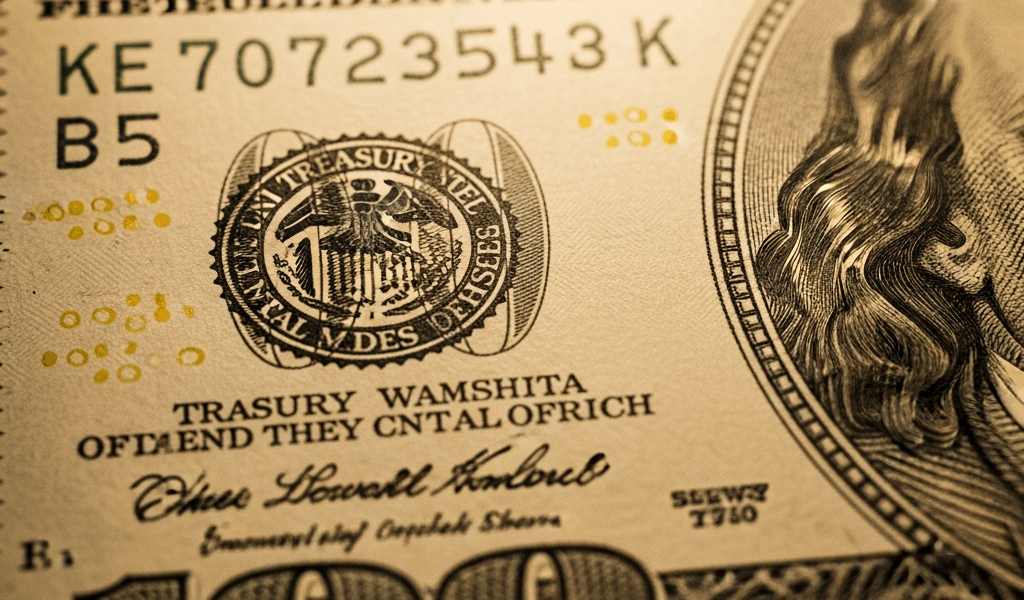
Check 1: Look at the seal color on the right side of the bill. You’ll see a circular seal next to Benjamin Franklin’s portrait. Is it red, green, or blue? This single detail tells you immediately whether you’re holding a pre-1950 bill or something printed after 1966. Red seals and blue seals are older. Green seals dominate bills from 1966 onward.
Check 2: Find the series date in the lower left corner. This is printed in larger text and says something like “Series 1928” or “Series 1950E.” Write this down. The year matters enormously for value — bills from 1928–1935 are meaningfully rarer than 1950s variants.
Check 3: Examine the serial number for patterns. It’s printed twice on every bill — upper right and lower left. Look for numbers under 1,000,000 (low serials), repeating digits like 11111111, or the letter “★” (a star symbol replacing the final digit). Any of these patterns suggest collectibility.
If your bill has a red or blue seal AND a series date before 1950 AND an unusual serial number, you probably own something worth more than face value. Green with a 1966+ date and normal serials? It’s worth $100.
Why Pre-1950 $100 Bills Command Higher Prices
The U.S. Bureau of Engraving and Printing produced vastly fewer $100 bills in the 1920s and 1930s than they do today. Fewer were printed. Fewer survived intact. Most got spent decades ago. The ones remaining are statistically rarer — and that’s really all it comes down to.
Two windows matter most for collectors: 1928–1935 (when the bill size was reduced and design changed significantly) and 1945–1950 (post-war production before the 1966 modernization). Bills from these eras appreciate because each series had shorter print runs. Older bills wear out or get destroyed naturally. A well-preserved 1928 $100 bill is genuinely scarce. A 1995 $100 bill is not.
Red Seal vs. Green Seal — What’s the Difference
Red seal $100 bills were printed from 1928 through 1966. That’s a 38-year window, but production wasn’t consistent. The 1928 and 1934 series are most sought-after. Green seal $100 bills started in 1966 and continue today — if you’re holding a green seal, it’s almost certainly worth face value unless it has an extraordinary serial number.
Here’s the practical breakdown:
- Red Seal (1928–1950s): Older production window. Typically worth $150–$600 depending on series date, condition, and serial number. A 1928 red seal in excellent condition might reach $1,000–$2,000.
- Blue Seal (1953–1963): Silver Certificate $100 bills. These are rarer and often worth $300–$800 if the condition is good. Collectors specifically hunt blue seals.
- Green Seal (1966–present): Modern bills. Face value unless the serial number is extremely unusual or it’s a 2-digit note (printed in the 1960s before numbering standards changed).
The color itself isn’t artistic preference — it indicated what the bill was backed by. Federal Reserve notes (green), silver certificates (blue), or gold certificates (gold, now nearly all owned by collectors). The seal color literally tells you the bill’s economic history.
Serial Numbers That Signal Hidden Value
Serial numbers are where $100 bills get interesting. Not all old bills are valuable. But certain serial number patterns are collected obsessively, and dealers pay premiums for them.
Low serials: Any serial number under 1,000,000 is collectible. A 1928 red seal with serial number 00000567 could be worth $500–$800 instead of $150. The lower the number, the higher the premium. Serials starting with single digits command the biggest markups.
Fancy serials: Repeating patterns like 11111111, 22222222, or 12345678 are highly desirable. A red seal $100 with repeating serials might sell for $400–$1,200 depending on the exact pattern and bill series — 88888888 is worth more than 11111111 in collector markets (eights are considered lucky).
Star notes: A star symbol (★) replacing the final digit means the bill was a replacement for a printing error. Star notes from the 1920s–1940s are scarce and worth $200–$600 premiums.
I once found a 1934 red seal with serial number 00012345. Thought it was worthless because I didn’t recognize the serial pattern significance. A dealer offered me $280 for it. The bill itself was only worth $120, but the sequential serial added $160 in value. That’s the lesson — serial numbers are invisible to casual observers but visible to collectors.
When Your $100 Is Just Worth $100
Here’s where I have to be honest about what you’ll actually sell these for. Online listings are full of “$100 bills worth $5,000” clickbait. Reality is messier.
A 1966 green seal $100 bill with normal serials? That’s $100. A 1950 red seal with normal serials and average wear? Maybe $120–$140 if a dealer feels generous. Even visually interesting bills need condition to command real premiums — a crumpled, stained 1928 bill is worth less than an uncirculated one, even though it’s the same series.
Condition matters more than most people assume. Collectors grade bills on a 1–70 scale. A note graded 64 (Choice Uncirculated) is worth 2–3x what the same bill would fetch at grade 55 (About Uncirculated). Creases, stains, and fading destroy value fast.
Bills that get hyped online but rarely sell for premium:
- 1966+ green seals under any circumstance
- 1950–1963 red seals with common serial numbers
- Any bill with obvious circulation wear
- “Lucky numbers” like 007 or 666 (dealers don’t care; collectors do, but supply is huge)
If your bill passes the three quick checks and has a genuinely rare serial or pre-1935 series date, next step is getting it graded by a professional service like PMG or PCGS. Grading costs $15–$50 but certifies authenticity and condition — that’s what dealers actually pay for. Or contact a local currency dealer and bring the bill in person. They’ll tell you in 30 seconds whether it’s worth pursuing.

Stay in the loop
Get the latest bank note buzz updates delivered to your inbox.