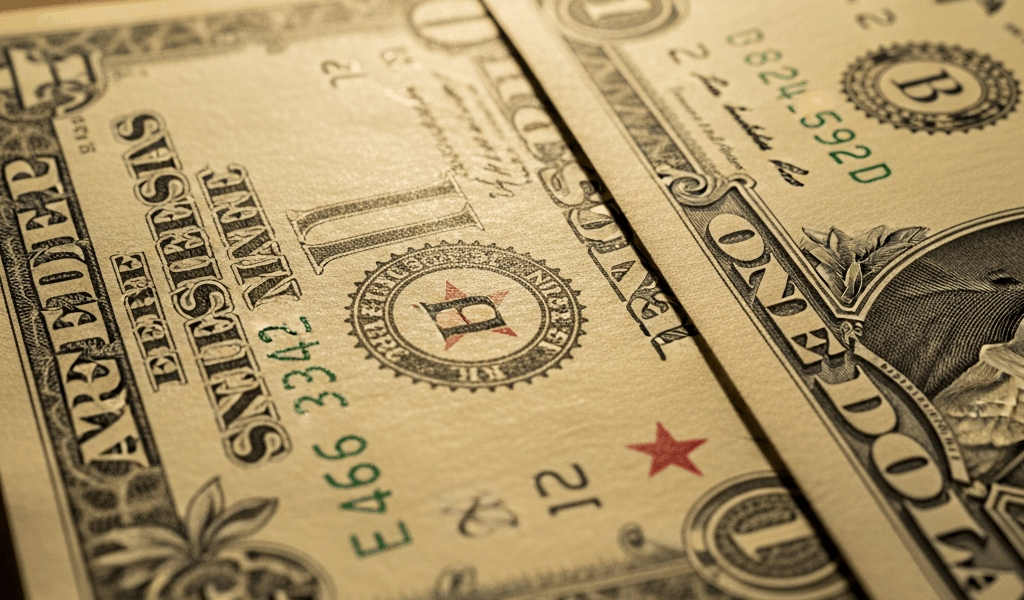
A star note is a replacement U.S. banknote identified by a star in its serial number. Some star notes sell for more than face value, but the star by itself does not guarantee a large premium. Collectors evaluate the exact series, denomination, issuing Federal Reserve Bank, production run, condition, serial-number appeal, and verified market demand.
This guide shows how to identify a genuine star note, research its production run using official Bureau of Engraving and Printing records, judge its condition, and estimate value from comparable sales without relying on viral price claims.
What Is a Star Note?
The Bureau of Engraving and Printing (BEP) uses replacement notes when an imperfect sheet is found after serial numbers have already been printed. Reprinting the exact discarded serial numbers would be inefficient, so replacement sheets receive their own serial numbers with a star in place of the usual suffix letter. The BEP explains this process on its official serial-number reference.
The star is therefore a production identifier, not an error added after the bill entered circulation. A genuine star is printed in the same ink and style as the serial number. It should not be confused with a stamp, stain, pen mark, or damage.
A star note remains legal tender for its denomination. The U.S. Currency Education Program confirms that star notes replace defective notes and recommends consulting a currency dealer or numismatic organization for an appraisal. A bank normally treats a $1 star note as one dollar; any collector premium comes from the numismatic market.
How to Identify a Star Note
- Place the note face up. Locate the serial numbers printed on the front.
- Look at the end of the serial number. On a modern Federal Reserve note, a star replaces the normal suffix letter.
- Record the complete identifiers. Write down the denomination, series year, full serial number, star, and Federal Reserve Bank letter.
- Check that both printed serial numbers match. If they do not, the note may need expert examination rather than a routine online lookup.
Do not clean, flatten with heat, tape, laminate, or write on a note while researching it. Those actions can reduce collector value. Handle a potentially collectible note by its edges and place it in an inert, currency-size holder.
Are Star Notes Valuable?
Some are, but many modern circulated examples are only modestly collectible. The useful question is not simply “Does it have a star?” It is “How desirable is this exact note compared with other notes from the same series and run?”
These factors usually matter most:
- Production run and total printing. Collectors often prefer notes from smaller replacement runs, but the complete series and district context matters.
- Condition. Crisp paper, original embossing, sharp corners, and the absence of folds, stains, tears, writing, or repairs can materially affect demand.
- Denomination and series. Demand differs among $1, $2, $5, $10, $20, $50, and $100 notes and among older and newer series.
- Federal Reserve Bank. The district letter helps identify the exact printing group and should be included in comparisons.
- Serial-number appeal. Very low numbers, solid digits, ladders, radars, repeaters, and other recognized patterns may attract a separate collector premium.
- Actual demand. Scarcity does not automatically create a buyer. Verified sales of genuinely comparable notes are stronger evidence than an asking price.
A common mistake is to apply the sale price of a pristine, graded, scarce-run note to a worn note that merely shares the same denomination. Another is to use an active marketplace listing as proof of value. Sellers can ask any price; completed sales show what buyers actually paid.
How to Check a Star Note’s Production Run
Start with official data. The BEP publishes monthly production reports that separate regular notes from star notes and identify denominations, series, Federal Reserve Bank letters, serial-number ranges, and quantities. Availability and report formats vary by year, so match every identifier rather than searching only the denomination.
- Read the series year exactly, including a letter such as “A” when present.
- Record the denomination and Federal Reserve Bank letter.
- Find the applicable BEP production report and locate the matching star-note line.
- Check whether the note’s serial number falls within the reported range.
- Save the report date and run details with your collection records.
Third-party lookup tools can make research faster, but verify important results against the BEP source. A database label such as “rare” is a research lead, not an appraisal.
How Condition Affects Star Note Value
Paper-money grading is stricter than a simple choice between “circulated” and “uncirculated.” Collectors look at folds, handling, corner wear, paper originality, color, margins, centering, stains, pinholes, tears, and repairs. A note that looks clean at arm’s length may still show circulation under angled light.
Use conservative language when describing a raw note. “Appears crisp with no obvious folds” is more defensible than assigning a professional numeric grade yourself. For a potentially important note, compare the cost and likely benefit of authentication and grading before submitting it. Routine modern notes can cost more to grade than the premium they are likely to receive.
How to Estimate What a Star Note Is Worth
- Identify the exact note. Match denomination, series, district, star, and serial-number range.
- Research production. Confirm the replacement run in BEP reports.
- Assess condition conservatively. Note every fold, stain, tear, mark, and repair.
- Search completed sales. Compare sold examples with the same identifiers and similar condition. Exclude unmatched denominations, series, districts, and unusually attractive serial numbers.
- Use several comparisons. One exceptional auction result does not establish the normal market.
- Account for selling costs. Fees, shipping, insurance, and dealer margins affect the amount a seller receives.
If there are no closely comparable sales, the honest conclusion may be that the market value is uncertain. For a high-value candidate, seek opinions from established paper-money dealers or numismatic organizations. Do not mail a note to an unknown buyer based only on a social-media message.
Star Note Value Checklist
- Denomination
- Complete series year
- Federal Reserve Bank letter
- Full serial number and star position
- BEP replacement-run range and quantity
- Visible folds, stains, tears, writing, pinholes, or repairs
- Unusual serial-number pattern
- Comparable completed sales
- Graded versus raw status
For related research, see our guide to checking valuable dollar-bill serial numbers and our explanation of fancy serial-number patterns.
Frequently Asked Questions
Does every star note have collector value?
Every star note may be interesting as a replacement note, but not every example has a meaningful premium above face value. Common runs in circulated condition can have limited demand.
Where is the star on a modern U.S. bill?
On modern Federal Reserve notes, the star replaces the suffix letter at the end of the serial number. Use the BEP serial-number guide to compare the format.
Can a bank tell me what my star note is worth?
A bank generally handles it at face value. Collector valuation is better researched through official production records, comparable completed sales, and qualified paper-money dealers or numismatic organizations.
Should I get my star note graded?
Consider grading when the note appears authentic, is in strong original condition, comes from a potentially scarce run, or has an especially desirable serial number—and when the likely benefit exceeds grading, shipping, and insurance costs.
What should I do first after finding one?
Do not spend or alter it. Record every identifier, protect it in an inert holder, check official BEP production data, and then compare verified sales of matching notes.

Stay in the loop
Get the latest bank note buzz updates delivered to your inbox.