Why Fancy Serial Numbers Make Bills Worth More
Fancy serial numbers have gotten complicated with all the misinformation flying around. I’ve spent the last three years building a collection of unusual currency, and I can tell you honestly—they’re not a gimmick. They’re the difference between selling a $100 bill for face value or getting $500 at auction. The serial number on your cash is what separates collectible currency from the stack in your wallet.
But here’s what most people get wrong. Not every weird serial number adds value. Collectors hunt for specific patterns — and knowing which ones actually move the needle on price is what separates serious collectors from people hoping their $5 bill with “funny” numbers will fund their retirement.
What Makes a Serial Number Fancy in the First Place
A fancy serial number is any pattern in the eight-digit code that stands out from random sequencing. In essence, it’s a recognizable design. But it’s much more than that.
Solid serials (also called “repeaters” or “all-same-digit” notes) are exactly what they sound like — all eight digits identical. Picture a $1 bill with the serial number 77777777. That’s a solid. The rarity depends on denomination and series. According to the Bureau of Engraving and Printing, solids print roughly 1 in every 11 million bills.
Radar notes, or palindromic serials, read the same forwards and backwards. Take 12344321 — that’s a radar. These are rarer than solids and command higher premiums because they’re harder to identify casually. You have to actually think about them.
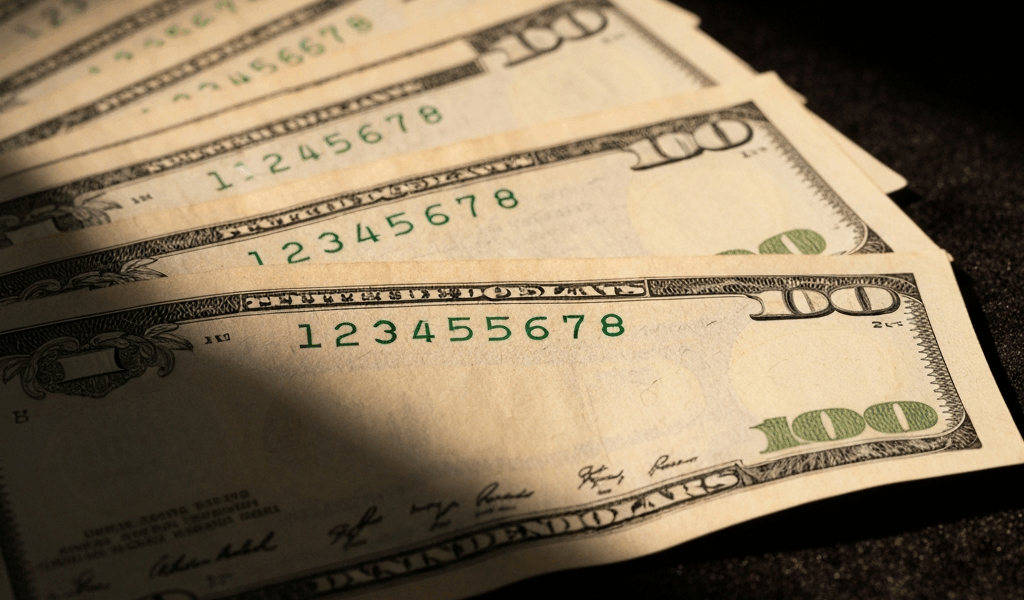
Ladder notes feature ascending or descending sequences. 12345678 or 87654321. Ladders are more common than radars or solids, but still scarce enough to catch collector attention — especially in crisp condition.
Low serials fill their own category. A bill numbered 00000123 has collectible status just from the low-number placement, regardless of whether there’s a fancy pattern involved.
Probably should have opened with this section, honestly. Most people think any repeating digit qualifies as “fancy.” It doesn’t. A bill with serial 11223344 (paired repeaters) is basically worthless premium-wise because the pattern isn’t recognizable enough and it prints too frequently to feel rare.
Solid Serial Numbers and Why Collectors Chase Them
Solids are the heavyweight champion of fancy serials. They’re instantly recognizable, impossible to miss, and they have a mathematical rarity that translates to real money.
A solid $1 bill in Fine condition (lightly circulated, no major damage) typically sells between $150–$400, depending on which digit repeats. The digit itself matters — 1’s and 2’s are the most common solids printed, so they’re slightly cheaper. 7’s, 8’s, and 9’s pull higher premiums because they’re psychologically more “interesting” to collectors.
The same solid in Crisp Uncirculated condition (never spent, sharp corners, bright color) jumps to $500–$1,200. I bought a solid 88888888 $1 bill in Crisp condition last year for $875. Three months later, another identical bill sold at a Heritage Auctions event for $950. That spread told me something.
For $5 bills, solid premiums get steeper. A solid 55555555 $5 note in Fine condition runs $300–$600. In Crisp condition, expect $1,200–$2,500. A $10 solid in Fine condition lands around $400–$800. In Crisp, you’re looking at $2,000–$4,500.
Why are solids so valuable? Psychological clarity — that’s what makes them endearing to collectors. Anyone can recognize 11111111 instantly. Grandparents show them to kids. Bartenders keep them framed. Solids have appeal beyond the collector market, which creates demand from regular people with disposable income.
The federal reserve prints roughly the same volume of bills across all years and series, so the rarity of solids stays relatively stable. That consistency makes them predictable to price, which is why dealers stock them confidently and collectors actively hunt them down.
Ladder Notes, Radars, and Palindromes Worth Real Money
Ladder serials are the trickier play. Frustrated by chasing patterns that don’t exist, serious collectors trained themselves to spot and dismiss the fakes. A perfect ascending ladder (12345678) or descending ladder (87654321) is genuinely rare. Near-ladder patterns? Common enough that you shouldn’t waste your time.
A true $1 ladder note in Fine condition typically sells for $80–$200. In Crisp condition, you’re at $300–$700. The key word is “true” — the sequence must be absolutely clean, with no skipped numbers or reversals.
Radar notes command higher premiums precisely because they’re harder to spot. A $1 radar in Fine condition sells for $150–$350. In Crisp condition, $600–$1,500. I studied a sales database from Paper Money Guaranty (PMG) this past year, and a radar 97544579 $1 bill in Extremely Fine condition closed at $1,625.
Here’s where it gets interesting — a $100 bill with a radar serial moves completely different money. Because $100 bills are already higher denomination, collectors pay harder for any fancy pattern. A $100 radar in Fine condition easily hits $800–$1,500. In Crisp, you’re looking at $3,000–$6,000 minimum. The same $100 bill with a standard serial in identical condition? Worth maybe $150–$300.
That’s a 15–30x markup for having the right pattern.
Near-ladder patterns (like 12345677 or 87654322) are where people waste time and money. They’re common enough that serious dealers won’t even price them above a few dollars above face. Don’t hunt these.
Low Serial Numbers vs. Fancy Serials—Which Adds More Value
Low serials are their own beast. A bill numbered 00000001 through 00000100 has collectible status independent of any pattern. Collectors call these “low serials” and they’ve commanded premiums for decades.
Here’s the honest ranking: solids outpace low serials. A solid beats a low serial in collector demand every single time. But a low serial beats a regular bill — no question.
| Serial Pattern | $1 Bill (Fine Condition) | $100 Bill (Fine Condition) |
|---|---|---|
| Solid (88888888) | $150–$400 | $800–$1,500 |
| Radar (97544579) | $150–$350 | $800–$1,500 |
| Ladder (12345678) | $80–$200 | $600–$1,200 |
| Low Serial (00000042) | $20–$60 | $150–$400 |
| Regular Serial | $1–$5 | $100–$120 |
Low serials in the 00000001–00000050 range add maybe $15–$50 to a $1 bill. The earlier the number, the higher the premium. Serial 00000001 specifically can hit $300–$600 even in lower grades because it’s historically significant and coveted.
But a low serial doesn’t compete with a solid in the same condition. If you find yourself choosing between a low-serial $1 and a solid $1, the solid wins collector attention and resale value every time.
Red Flags—Fancy Serials That Don’t Actually Pay Off
I’m apparently someone who didn’t do enough research early on. Spent $25 on a bill with serial 11221122 thinking I’d found a gem. Tried to sell it two years later for $15. Got offered $3. Don’t make my mistake.
Paired repeaters (11221122, 33443344) look fancy to untrained eyes. They don’t move collector interest because the pattern isn’t distinct enough and they print regularly enough that dealers dismiss them immediately.
Sequential repeaters that skip numbers (11223344, 99887766) fall into the same trap — too common, not recognizable enough as a “pattern.”
Be careful with what auction sites call “fancy serials” too. eBay sellers will tag any bill with repeating digits as fancy and price it aggressively. Most of those sales close far below asking. The listings that actually sell? Solids, true radars, and low serials 1–50.
A solid rule: if the pattern isn’t instantly recognizable to someone with no collector knowledge, it probably won’t command premium pricing.
How to Grade and Price Your Own Fancy Serial Bill
Condition is everything. A solid serial on a heavily circulated, bent, stained bill sells for 60–70% less than the same serial in Crisp condition. That difference matters more than you’d think.
While you won’t need extreme precision, you will need a handful of grading basics. Circulated bills range from Poor (P) through Fine (F). Uncirculated grades run from About Uncirculated (AU) through Gem Crisp Uncirculated (GCU). A bill with visible creases, fading, or edge damage drops into Fine or Extremely Fine territory, which cuts your solid serial value from $800–$1,200 down to $150–$400 on a $1 bill.
Take a solid 77777777 $1 bill. In Poor condition (heavy wear, stains, tears), you’re at $50–$100. Fine condition, $150–$400. Extremely Fine, $400–$800. Crisp Uncirculated, $600–$1,200. That progression tells you everything.
The condition jump from Fine to Crisp is typically 3–5x the value on fancy serials. That’s why hunting for Crisp condition bills matters obsessively.
First, you should check your bill under bright light for any fold creases — even light ones matter. Run your finger across the surface. Does it feel smooth or textured from circulation? Are the corners sharp or rounded? Is the ink bright or faded? These details separate grades.
If you’re serious about selling, get your bill professionally graded by PMG or Certified Currency Grading Company (CCGS). A graded slab might be the best option, as the currency market requires third-party authentication. That’s because buyers trust the verification. A solid serial in PMG Crisp 66 Gem might fetch $1,100. The same bill ungraded typically sells for $800–$950. That 15–25% bump justifies the grading fee.
Your fancy serial bill is valuable. But only if you price it accurately and understand which patterns actually matter to serious collectors. Solids first. Radars second. Low serials third. Everything else is noise.

Stay in the loop
Get the latest bank note buzz updates delivered to your inbox.