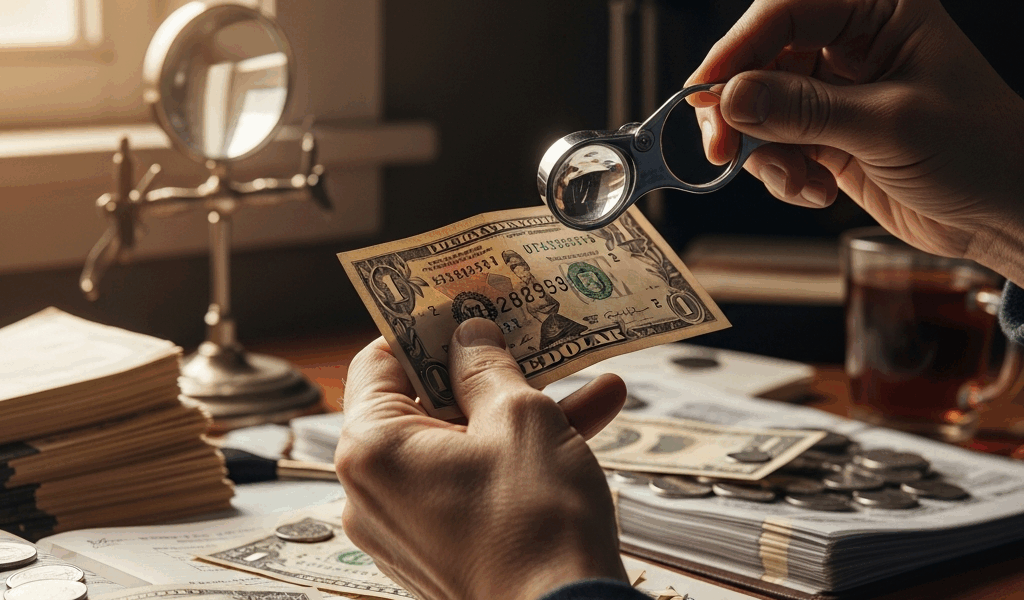
You’re flipping through a stack of bills and one serial number stops you cold — it reads the same backward as it does forward. That’s a radar note, and depending on which type you’ve got and what shape it’s in, you might be looking at anywhere from a fun conversation starter to a few hundred dollars above face value.
What Is a Radar Note?
A radar note — also called a palindrome note — is any bill where the eight-digit serial number reads identically from both directions. The number 68200286 is a radar. So is 01233210. The hobby borrowed the name from the word RADAR itself, which happens to be one of the English language’s most recognizable palindromes. Someone in the numismatic community noticed that irony decades ago, and the name stuck.
These aren’t printing errors. The BEP didn’t do anything unusual — the serial number simply landed on a palindromic sequence during normal production. But pattern-hunting is baked into the collector DNA, and palindromic serials are uncommon enough to carry premiums ranging from a couple of bucks to genuinely impressive numbers depending on the specific type.
The Three Types — Radar, Near Radar, and Super Radar
Not all palindrome bills trade the same way. The market recognizes three tiers, and the price gap between them is wider than most people expect.
True radar: All eight digits form a perfect palindrome. Examples: 68200286, 35299253, 01233210. Read it left to right, read it right to left — identical. This is what most collectors mean when they say “radar note,” and it’s where the bulk of buying and selling happens.
Near radar: Seven of eight digits create a palindromic sequence, but one digit breaks it. Something like 68200287 — tantalizingly close, but not a clean palindrome. Near radars are naturally more common and carry thinner premiums. Some collectors consider them worth keeping; others scroll right past them in listings. It depends on who’s buying that week.
Super radar: This is the tier that generates real money. A super radar has the same digit occupying both the first and last positions with a highly symmetric internal pattern. Think 08888880 or 02222220 — the outer digits frame a repeating core. More restrictive collectors insist the first two and last two digits must match. Either way, super radars are genuinely scarce and command the highest premiums in the fancy serial number world.
Worth noting the neighboring categories: ladder notes (ascending or descending sequences like 12345678) and bookend notes (first and last digit groups match, like 3456xxxx3456) are separate collectible types. Dealers sometimes bundle them under the “fancy serial number” umbrella, but they’re not subtypes of radar notes.
How Common Are Radar Notes?
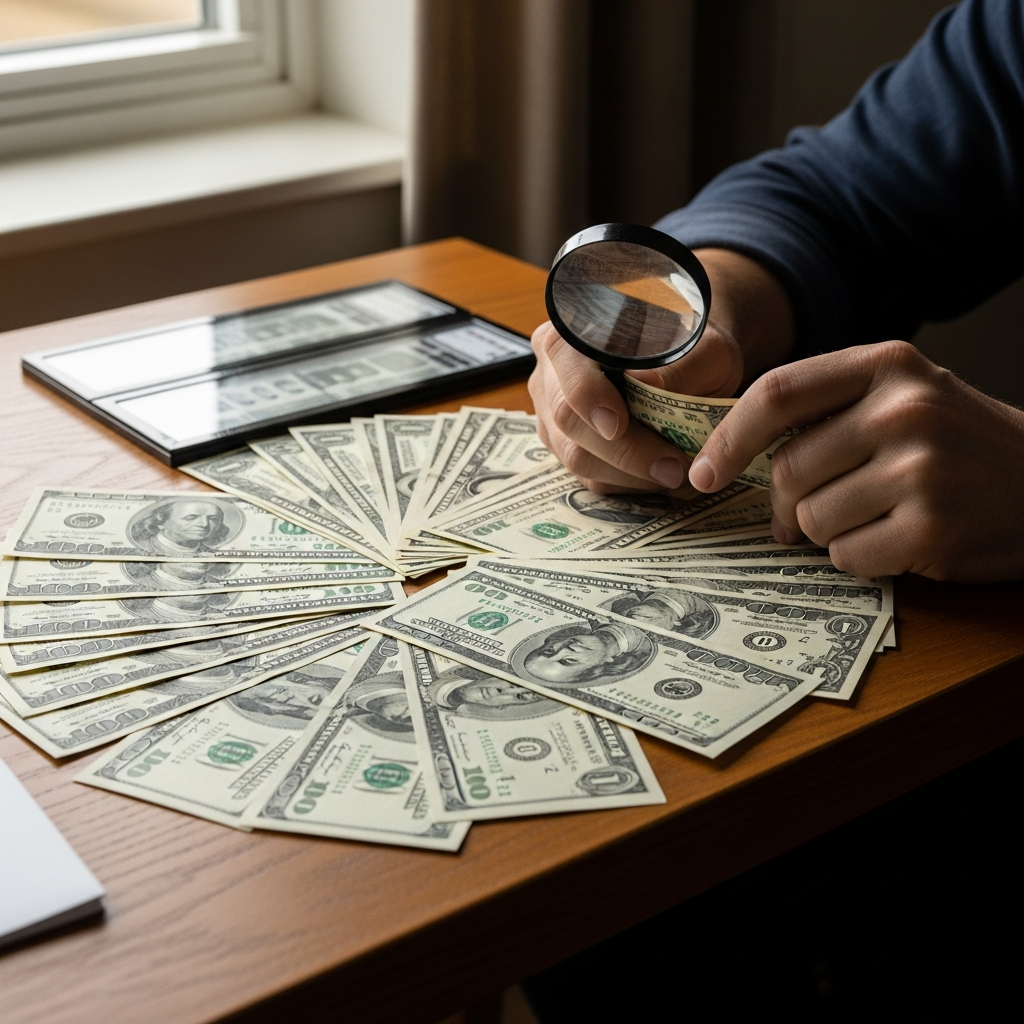
Here’s the math. An eight-digit serial number has 100 million possible combinations — 00000000 through 99999999. For a true radar, the last four digits are locked in by the first four. If your serial starts 6820, it has to end 0286 for the palindrome to work. That gives you 10,000 possible radar combinations out of 100 million. Roughly 1 in every 10,000 notes.
Sounds rare until you think about printing volume. The BEP churns out billions of notes annually. In a single production run of 3.2 million bills, you’d expect about 320 radars to exist. They’re uncommon enough to be worth pulling from circulation, but not so scarce that finding one requires divine intervention. Crack open a few bank straps and you’ll eventually spot one.
Super radars are a completely different calculation. The pattern constraints are much tighter, and depending on how strict your definition runs, a super radar might show up only once in every 100,000 to 1,000,000 notes. Pulling one out of a register drawer is genuinely unusual, and auction prices reflect that rarity.
Realistic Value Ranges
I want to be honest here because the online hype machine has inflated expectations around radar notes. Here’s what these bills actually sell for, drawn from completed eBay listings and Heritage Auctions / PMG auction records:
True radar, circulated: $5 to $25 above face value on $1 notes. A worn radar $20 typically moves for $25 to $40 total. The pattern is the attraction, not the condition, so even well-traveled radars find buyers — just toward the bottom of the range.
True radar, uncirculated: $25 to $100 on common denominations. A crisp $1 radar sitting in a PMG 65 slab sells pretty consistently in the $40 to $75 range. Jump to an uncirculated $100 radar and you’re looking at $150 to $200.
Near radar, any condition: $2 to $10 above face. Honestly, some near radars don’t move at all if the pattern isn’t visually obvious. Collectors chasing radars want the real thing — close doesn’t quite cut it for most buyers.
Super radar, uncirculated: $200 to $1,000+. A super radar $1 note like 08888880 graded PMG 67 has brought over $500 at Heritage. Super radars on $100 bills in gem condition have cleared $1,000. Supply is legitimately limited, and the buyers in this tier know exactly what they’re after.
One quirk I’ve noticed watching this market: visually striking digit patterns outperform “ugly” radars even when both are technically perfect palindromes. A radar like 88888888 (which doubles as a solid serial — another collectible category) will crush a radar like 37411473 at auction, even though the math is identical. Aesthetics matter to buyers.
How to Check and Submit Your Note
Confirming a radar is the easy part — just read the serial number forward, then backward. If it matches, you’ve got one. No BEP databases to consult, no print run lookups needed. The information is right there on the face of the bill.
The real decision is whether to get it professionally graded. My rule of thumb:
Grade it if the note is uncirculated — no folds, no handling marks you can see without magnification — and it’s either a true radar with a visually appealing pattern or any super radar regardless of condition. PMG’s economy tier runs $20 to $30 per note. On a clean radar, the price jump from raw to slabbed typically covers grading costs with room to spare. A raw uncirculated radar $1 that brings $30 loose could sell for $50 to $65 once PMG puts a number on it.
Sell it raw if the note shows circulation wear or it’s a near radar. Grading fees on a $10 near radar would eat the entire premium. List it on eBay with sharp photos of both sides, work “radar note” and “palindrome serial number” into your title, and price it against completed (sold, not listed) comparables.
Where to sell: eBay completed listings are still the gold standard for pricing fancy serial number notes. Filter by “Sold” to see what actually cleared, not what someone hoped to get. For high-end pieces — super radars, gem-graded true radars on big denominations — Heritage Auctions and specialty numismatic houses pull a stronger buyer pool than eBay typically delivers.
Collector forums are worth watching too, especially the fancy serial number sections on major currency boards. The radar note community isn’t massive, but it’s organized and active. You’ll pick up pricing intel and occasionally connect with buyers hunting specific patterns who are willing to pay retail to complete a set.


Stay in the loop
Get the latest bank note buzz updates delivered to your inbox.