What Makes Large Size Bills Different
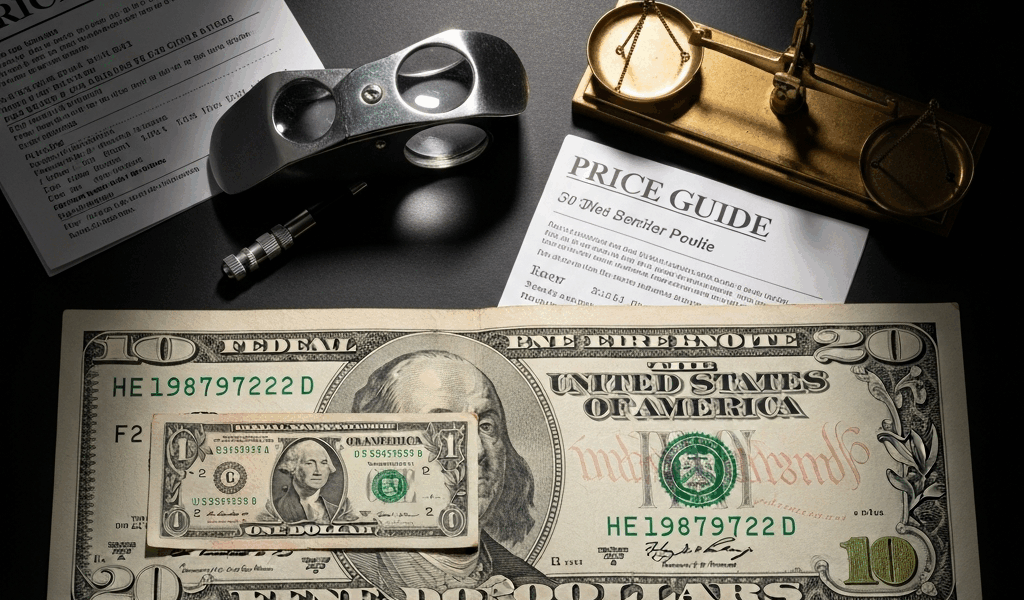
Large-size bills have gotten complicated with all the collector mythology flying around. Here’s the reality: they demand higher prices for one straightforward reason — they’re fundamentally scarcer than their modern counterparts. A large-size bill, produced before 1929, measured 7.42 inches by 3.12 inches. Then the U.S. Bureau of Engraving and Printing shrunk banknote dimensions to 6.14 inches by 2.61 inches, and small-size bills have dominated circulation ever since.
The change wasn’t arbitrary, though. By the late 1920s, larger notes took up too much space in wallets and cash registers. Smaller bills reduced paper costs and manufacturing complexity. From a collector’s perspective, this switchover created a hard dividing line — everything printed before 1929 belongs to one category, everything after to another.
Physical size matters. A lot, actually.
When you hold a large-size $50 bill next to a modern $50, the difference is impossible to miss. The older note feels substantial — genuinely heavier in your hand. The artwork sprawls across more real estate. Design elements like vignettes, serial numbers, and Treasury signatures occupy larger spaces, which often means finer detail work and more intricate engraving. Small-size bills compress the same information into a tighter footprint, which fundamentally changes how collectors perceive value.
Here’s what actually sealed the fate of large-size notes: circulation patterns. They spent decades moving through banks, stores, and pockets before smaller bills displaced them entirely. Most got destroyed, redeemed, or wore out completely. The Federal Reserve systematically pulled large-size currency from circulation and either destroyed it or locked it away. Probably should have opened with this section, honestly — the scarcity story explains everything that follows.
Price Gaps Between Large and Small Size Notes
Let me walk through actual pricing to show the gap. Take a 1900 $20 Legal Tender large-size note in fine condition (grade 12 on the 70-point scale). You’re looking at $800 to $1,200 depending on exact series and provenance. Now compare that to a 1950 $20 Federal Reserve small-size note in the same fine condition. Price range? $40 to $80.
That’s roughly a 15-to-1 markup for the large-size version.
The gap widens dramatically with rare series. A 1901 $10 Bison large-size bill in very fine condition (grade 25) can fetch $3,500 to $5,000. The comparable 1963 $10 small-size note in matching condition runs $35 to $60. Now you’re looking at 60-to-1 pricing differences — sometimes higher for truly scarce varieties.
Why the massive spread? Rarity dominates everything else. Large-size bills had shorter production runs overall. National Bank Notes, issued by thousands of regional banks from 1863 to 1935, varied dramatically in survival rates depending on which bank printed them. A large-size note from a failed bank in rural Montana survives less frequently than currency from major Eastern financial centers. Smaller population centers meant fewer notes printed initially, and far fewer remaining today.
Demand amplifies the effect considerably. Collectors actively compete for large-size material because:
- Older notes appeal to both currency specialists and general antique collectors looking for tangible history
- Historical prestige matters — large-size bills connect directly to America’s industrial age and early 20th-century economic boom
- Investment perception treats large-size as “blue-chip” currency, similar to how vintage coins command premiums over modern strikes
- Supply is genuinely constrained — you can’t produce more large-size bills, period
Small-size bills, by contrast, printed in absolutely astronomical quantities. The Federal Reserve produced billions of $1 and $5 notes in small-size format throughout the 20th century. Even “rare” small-size varieties exist in populations of thousands or tens of thousands. That sheer abundance crushes pricing power entirely.
Rarity and Condition Hit Large Size Notes Harder
Condition swings hit large-size notes with exaggerated force — I learned this the hard way. I purchased what I thought was a fine-grade 1907 $50 National Bank Note for $2,400, only to have a professional grader downgrade it to very good (20) due to subtle staining I’d completely missed. The same note in that lower grade sells for $1,200 to $1,600. That’s an $800 swing on a single note.
Here’s why condition matters more for large-size varieties:
Large-size notes circulated for decades before removal from service. A $20 bill from 1905 spent 20+ years in actual circulation — passed hand to hand, folded into pockets, exposed to tobacco smoke and moisture. Small-size bills entered circulation around 1929 onward, but many surviving examples never circulated heavily because collectors began preserving them within a generation. Large-size notes didn’t have that luxury. Collectors didn’t actively pursue them until the 1960s and ’70s, by which time most circulated examples already showed significant wear.
Grading implications cascade downward dramatically. A large-size note graded fine (12) might be worth $800. Drop it to very good (8), and you’re at $400. That’s a 50% valuation hit right there. For small-size notes, the same grading drop typically runs 20-30% because baseline values are lower and percentage swings compress in absolute terms.
Specific series that hold condition premiums best include:
- 1901 Bison Notes — Iconic imagery appeals broadly; high-grade examples appreciate 15-25% annually without fail
- Series 1880 $100 Gold Certificates — Rarity combined with historical significance; grades above 30 command exponential premiums
- 1875-1878 National Bank Notes from failed regional banks — Scarcity multiplied by condition creates $10,000+ spreads between fine and choice uncirculated grades
- 1917-1923 Federal Reserve Notes (large-size) — Better survival rates than earlier issues, but condition still drives 40-60% value differences
The math is brutal. A choice uncirculated (64) large-size $20 from 1900 might sell for $4,500. The same note, one grade down at 63, drops to $3,200. That single grade point represents a $1,300 shift. For collectors, this means large-size bills demand expertise — you need confidence in your grading ability or trust a third-party grading service implicitly.
Which Large Size Bills Are Worth Hunting For
Not all large-size notes perform equally across the market. Clear winners and laggards emerge when you examine actual sales data.
National Bank Notes consistently outpace other large-size categories by a significant margin. Why? They appeal to geographic collectors — someone from Maine hunts for Maine National Bank Notes regardless of grade or denomination. That collector-by-location demand creates secondary bidding wars. A fine-condition $5 National Bank Note from an obscure Vermont bank might fetch $300-500, while a comparable Federal Reserve Note from the same era sells for $100-150. The geographic angle adds a 3-5x multiplier to baseline values.
Within National Bank Notes, certain series and banks hit premium prices consistently. Notes from banks that failed during the 1930s Depression carry extra collector appeal — they represent financial history in tangible, holdable form. A $20 National Bank Note from a failed Chicago bank in choice condition (63-64) regularly sells for $1,200-1,800, roughly double what an equivalent surviving note from a still-operational major bank commands.
Red Seal Federal Reserve Notes (1914-1963, large-size varieties through 1928) punch above baseline pricing. Red ink on the seal signals vintage unmistakably, and that visual distinctiveness attracts new collectors immediately. A 1918 $5 Red Seal in fine condition runs $180-280. The corresponding small-size Red Seal from 1953 in matching condition? $15-25. The large-size version gains 10-15x premium largely due to age and genuine rarity.
Gold and Silver Certificates represent another strong category worth pursuing. These notes literally represent warehouse holdings of precious metals, which resonates deeply with collectors interested in commodity-backed currency. A 1906 $20 Gold Certificate in very fine (25) condition sells for $600-900. Most small-size Gold Certificates (primarily 1928-1957 issues) sell for $50-150 in equivalent grades. Again, the large-size versions dominate pricing substantially.
High-denomination notes — $50 and $100 large-size bills — command premiums based on absolute face value psychology. A collector feels they’re acquiring something more “valuable” by owning a $100 note versus a $5 note, even when condition and rarity are objectively equivalent. This bias inflates large-size $50 and $100 pricing 20-30% above what rarity and condition alone would predict.
Should You Invest in Large Size Over Small Size
The collector question isn’t whether large-size bills are worth more — they obviously are. The real question is whether the premium justifies your budget and investment timeline.
Entry costs differ drastically. You can build a respectable small-size collection with $500-1,000. A comparable large-size collection requires $3,000-5,000 minimum. That’s a 5-10x capital requirement upfront, which represents significant friction for most collectors.
Liquidity matters enormously. Large-size notes sell more slowly because fewer collectors pursue them actively. You might wait 6-12 months to find the right buyer for a specialized large-size note. Small-size notes move faster — broader collector base means quicker sales at auction or through dealers. If you need to convert to cash, small-size offers genuine flexibility.
Appreciation trajectories differ measurably. Large-size notes appreciate 5-8% annually on average, driven by scarcity and steady collector demand. Small-size appreciation runs 2-3% annually. Over 20 years, $5,000 invested in large-size notes grows to roughly $13,000-$20,000. The same $5,000 in small-size grows to $6,500-$8,000. Large-size wins, but that assumes you pick strong varieties and maintain grades meticulously.
Storage is simpler with large-size — fewer notes occupy more visual and monetary value, so your collection feels substantial on limited shelf space. Small-size requires more pieces to reach equivalent dollar values, which some collectors prefer (diversification psychology) and others find tedious.
My honest take: large-size bills reward patient collectors with research discipline. You need to understand National Bank Notes inside and out, recognize strong regional banks versus weak ones, spot condition problems that trip up casual buyers, and wait for the right acquisition moments. If you’re willing to invest that effort, large-size appreciation outpaces small-size meaningfully. If you prefer lower entry costs and faster market liquidity, small-size makes considerably more sense.
The pricing gap exists because scarcity is real, not speculative. Large-size notes can’t be reprinted — they’re genuinely harder to find. Collectors price them accordingly. Whether that premium aligns with your investment goals depends on your capital, timeline, and patience for specialized collecting work.


Stay in the loop
Get the latest bank note buzz updates delivered to your inbox.