“`html
Why Silver Certificate Counterfeits Matter
I picked up my first silver certificate at a flea market back in 2019. The vendor casually mentioned it might be worth “a few hundred,” and I immediately wondered if I was holding a fake. Turns out, I wasn’t—but the panic was justified. Counterfeits exist, and honestly, they’re more common than most people realize.
Modern reproductions flood eBay and casual collections everywhere. Most aren’t attempts to defraud the Federal Reserve (that’s a federal crime, obviously). Instead, they’re novelty reprints, fantasy notes, or genuinely convincing fakes made overseas for souvenir markets. A real 1935 $5 silver certificate might fetch $30 to $500+ depending on condition and series. A counterfeit? Zero value, and you’ve wasted time and shelf space.
Probably should have opened with this section, honestly: authentication matters before you price anything or consider selling. A single misidentified bill erodes your credibility as a collector or heir managing an inherited collection.
Check the Paper and Weight First
Before you squint at ink patterns, feel the bill. Real silver certificates use a blend of 75% cotton and 25% linen — this creates a distinct tactile signature that fakes rarely nail.
Grab a scale if you have one handy. A genuine $5 silver certificate weighs roughly 1 gram (0.035 ounces). A $10 certificate runs about 1.1 grams. A $20 certificate hits 1.2 grams. Modern counterfeits printed on regular paper or cheaper stock? They often feel noticeably lighter or, occasionally, heavier if they use cardstock.
Now rub your thumb across the surface — and I mean actually feel it. Real bills have a slightly rough, linen-like texture. They don’t feel glossy or slick like regular paper. Run your finger along the portrait. Authentic relief printing (the raised ink technique used on the front) creates a subtle ridge you can actually feel. Counterfeits often feel completely flat or over-embossed, creating an artificial bump that’s too pronounced.
The paper itself should have a faint blue-gray tint under natural light, not pure white. Hold it up to a window. Counterfeits printed on bright white paper fail immediately. Thickness varies slightly, but a real bill sits at roughly 0.0043 inches. Use calipers if precision matters to you — most casual fakes won’t match this specification.
Examine the Printing and Ink
This is where vision matters more than touch. Set the bill under bright, indirect light — natural sunlight is best, but a desk lamp works fine.
Look at the borders and fine lines first. Real silver certificates have crisp edges where colors meet. The black ink line separating the portrait from the background should be sharp, not blurry or feathered. Counterfeits often show ink bleeding — the edges look fuzzy or colors slightly overlap. This happens because fakes use different printing presses or processes than the Bureau of Engraving and Printing.
Check the background pattern next. Behind the serial numbers and around the borders, you’ll see a repeating geometric design. On real bills, this pattern is consistent and microscopically fine. Counterfeits either show a blurry background or one with visible screen dots — a telltale sign of inkjet or offset printing rather than intaglio printing, the official method.
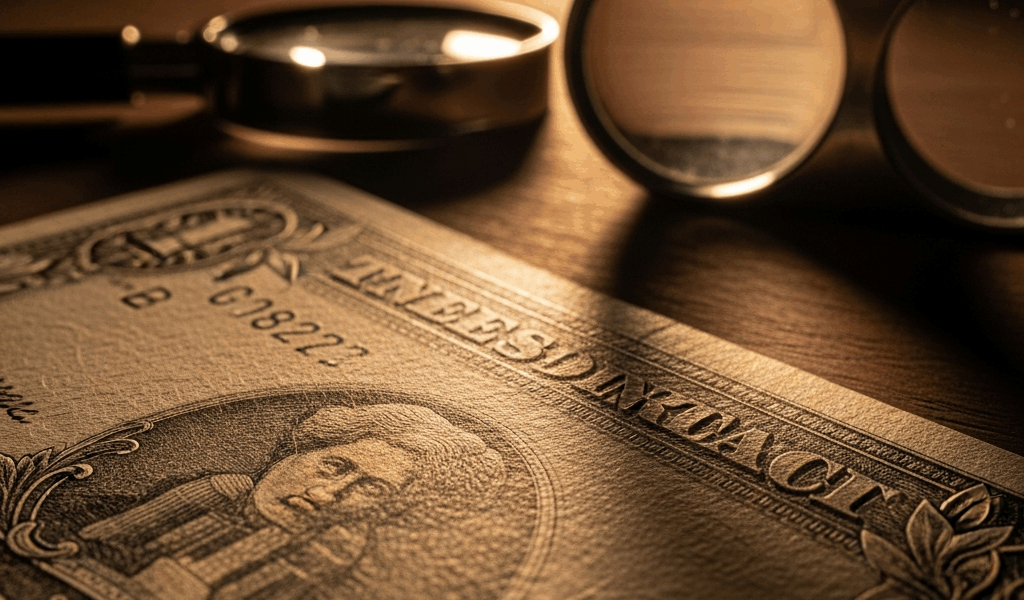
Find the microprinting — tiny text visible only under magnification. On a $1 silver certificate, you’ll see “THE UNITED STATES OF AMERICA” repeated in the lower left corner. A 10x magnifying glass reveals the text clearly on authentic bills. Counterfeits either lack microprinting entirely or show distorted, illegible text.
The portraits themselves matter more than you’d think. Alexander Hamilton’s hair on a $10 bill should show fine line work. Lincoln’s beard on a $5 should feel textured, not smooth. Real intaglio printing creates depth through slight ink buildup. Counterfeits often flatten this detail, making faces look two-dimensional and lifeless.
Color is a subtler check. Real $5 bills have black ink on the front, green and black on the back. The green should be a specific shade — neither too bright nor too dull. Genuine $10 bills use orange-tinted ink on the back. $20 bills feature purple and black accents. Counterfeits sometimes use the wrong ink colors entirely, or the colors fade inconsistently under light.
Look for Security Features by Era
Silver certificates changed over time. Knowing what era you’re examining prevents false positives.
Pre-1935 bills (Red seals) are rarer and didn’t include modern security features. If you’re holding one, focus on paper quality, printing sharpness, and ink consistency. Red seals used a specific pigment — the color should be deep and matte, not glossy or faded. These early certificates are counterfeited less often because they’re harder to find legitimately, reducing incentive.
1935–1957 bills (Blue seals) are the most common in circulation. These should have a security thread embedded in the paper. Hold the bill up to light. You’ll see a thin, embedded strip running vertically. The thread itself should have text reading “SILVER CERTIFICATE” alternating with the denomination. Counterfeits either lack this thread entirely or show a printed line instead of an actual embedded thread.
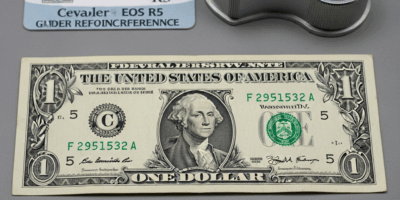
Serial numbers are another era marker. Pre-1935 bills use different numbering formats and fonts than post-1935 ones. The Treasury seal on the right side of the front changes style and color by era. On 1935-era bills, the seal is smaller and more intricate. On later versions, it’s larger and simpler. Compare your bill to a reference image from a trusted source — the Bureau of Engraving and Printing website or CoinAndCurrencyInstitute.org work well.
The reverse (back) side should show an eagle. On authentic bills, the eagle’s feathers are finely detailed and consistent. Counterfeits often simplify this design or show blurry feather work.
When to Get a Professional Assessment
You’ve done the tactile and visual checks. You’re 80% confident. When do you stop and call an expert?
If the bill passes all the checks above, you likely have an authentic certificate. For personal collections — family heirlooms you’ll never sell — this is usually enough. You’ve verified it’s real, and that’s the practical goal.
If you’re selling or trading, certification adds credibility fast. PCGS (Professional Coin Grading Service) and PMG (Paper Money Guaranty) are the two major graders. A certification costs $20–$100 depending on the bill’s stated value and turnaround speed. They assign a grade (condition rating from 1–70) and encapsulate the bill in a tamper-evident holder. Serious collectors trust certified grades — I’ve apparently become one.
High-value bills — anything you believe is worth over $200 — should go through grading before you attempt a private sale. Dealers often won’t buy ungraded currency over a certain threshold. Certification protects both you and the buyer.
One mistake I made: I tried to sell a supposedly rare $2 bill through a local dealer without certification. He was skeptical and offered $3. I got it graded, and it became a $25 bill. The grading fee was $25, so I broke even, but the lesson stuck — certification isn’t just for validation, it’s for accurate pricing.
Contact a local coin and currency dealer for recommendations. Many offer free preliminary assessments. They’ll tell you whether grading makes economic sense for your specific bill. If you’re overseas or far from dealers, PCGS and PMG accept mail submissions with prepaid shipping labels.
Silver certificates remain popular with collectors and casual hoarders alike. Knowing the difference between real and fake takes 15 minutes and no equipment beyond a magnifying glass and natural light. Start with texture, move to printing details, confirm era-specific features, and decide whether professional grading pays for itself. You’ll protect your collection and avoid the embarrassment of trying to sell a counterfeit.
“`

Stay in the loop
Get the latest bank note buzz updates delivered to your inbox.