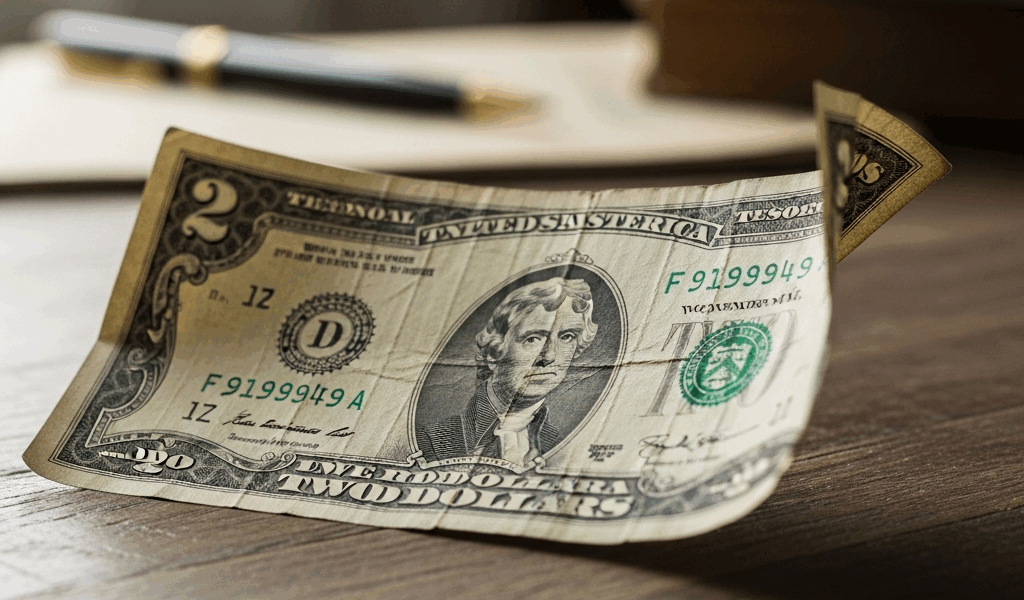
1953 Red Seal Two Dollar Bill — What Is It Actually Worth?
The 1953 two dollar bill red seal value question has gotten complicated with all the misinformation flying around — on collector forums, at estate sales, and honestly in about half the emails I get every week. As someone who’s been handling paper currency for fifteen years, I’ve learned everything there is to know about these notes. Somewhere north of four hundred personally evaluated. The answer most people don’t want to hear? The majority are worth three to five dollars. Full stop. But there are real exceptions — specific enough that you need to understand the details before you sell anything or shove it back in a drawer.
The Bad News — Most Are Worth $3–5
Pulled from a grandmother’s Bible or found wedged behind a dresser drawer, the average 1953 red seal two dollar bill arrives worn, soft, and honestly not worth much more than the paper it’s printed on — relatively speaking. The Bureau of Engraving and Printing produced over 79 million standard series 1953 notes. That’s not a typo. Seventy-nine million.
High mintage kills collector value. Always has. When something is common, it doesn’t matter how old it looks or how cool that red seal is — supply and demand doesn’t care about sentimental attachment.
Here’s what circulated examples actually sell for right now:
- Well-worn, heavily circulated — $2 to $3 (barely above face)
- Fine condition, moderate wear — $3 to $5
- Very Fine, light folds — $5 to $8
- Extremely Fine, barely handled — $10 to $15
- Uncirculated, crisp and bright — $20 to $30
Don’t make my mistake. Early in my collecting days I handed $18 to a flea market dealer who swore his 1953 two dollar bill was rare — said it with total confidence, even pointed at the red seal like it was proof. It wasn’t rare. Standard series, Very Fine condition, available at any currency show for around $6. I knew this about thirty seconds after getting home and checking a price guide. Do the research before you hand over cash, not after.
The red seal itself isn’t what makes these notes valuable. It just identifies the note as a United States Note — a Legal Tender Note — rather than a Federal Reserve Note. Red seal two dollar bills ran from 1928 through 1963. They look distinctive, sure. But “distinctive” and “scarce” aren’t the same thing.
Series Variants That Matter
Here’s where most other articles fail you. They say “1953 red seal two dollar bill” like that’s one single thing. It isn’t. Four distinct series fall under that umbrella, and they do not carry identical values.
Series 1953
The base series — printed in the largest quantity of the four. Signatures belong to Secretary of the Treasury Ivy Baker Priest and Treasurer of the United States Georgia Neese Clark. These are the most common ones you’ll encounter. Standard circulated examples run $3–5, uncirculated examples top out around $25–30 at retail.
Series 1953A
Signatures changed here — Elizabeth Rudel Smith took over as Treasurer, while Ivy Baker Priest stayed on as Secretary. Slightly fewer printed than the base 1953, but not dramatically fewer. Values track closely with the original: $3–5 circulated, $20–28 uncirculated. Not a meaningful jump across most grades.
Series 1953B
This is the one worth paying attention to. The 1953B had a noticeably smaller print run than either the base series or the 1953A — signatures belong to Secretary Douglas Dillon and Treasurer Elizabeth Rudel Smith. In uncirculated condition, a 1953B can legitimately fetch $30–40 retail. In Very Fine, you’re looking at $8–12 versus $5–8 for the commoner series. It’s not a moonshot — don’t let anyone charge you $200 for one — but the premium is real and measurable.
Series 1953C
The final series in this family. Secretary Douglas Dillon again, with Treasurer Kathryn O’Hay Granahan. Print run fell somewhere between the 1953A and 1953B in size. Values land in moderate territory — a touch above the base 1953 in uncirculated grades, roughly $25–35 — but not dramatically so. In circulated grades, honestly, the difference between a 1953 and a 1953C is maybe a dollar or two at most.
The series letter is printed directly on the face of the note, just to the right of the series year. It reads “Series of 1953” or “Series of 1953A,” and so on. Small but readable without magnification on any note that isn’t heavily worn.
Star Notes — The Exception
Probably should have opened with this section, honestly, because star notes are the legitimate reason to get excited about a 1953 red seal two dollar bill — and most people have never heard the term.
But what is a star note? In essence, it’s a replacement bill — one printed to substitute for a note damaged or destroyed during manufacturing. But it’s much more than that. When the Bureau of Engraving and Printing produces these replacements, they mark each one with a small star symbol (★) at the end of the serial number instead of a letter suffix. That’s what makes star notes endearing to us collectors — smaller print runs, built-in scarcity, and something actually worth hunting for.
How to Identify a Star Note
Look at the serial number on the face of your bill. A standard note ends with a letter — something like A12345678B. A star note ends with a small star — A12345678★. Unmistakable once you know to look for it. The serial number is printed in red on these notes, same color as the seal, which makes spotting that star even easier in decent light.
What Star Notes Are Worth
Here’s where values actually get interesting:
- 1953 star note, circulated Fine — $8 to $15
- 1953 star note, Very Fine — $15 to $22
- 1953 star note, uncirculated — $25 to $45
- 1953B star note, uncirculated — $60 to $90 (smaller print run compounds the scarcity)
- 1953C star note, uncirculated — $45 to $65
I once passed on a 1953B star note in AU condition at a Baltimore currency show — $55, dealer seemed confident, I thought he was stretching. Pulled up the PCGS Currency price guide on my phone that night in the hotel room. He was actually slightly under market. Bought a different note instead. Still mildly annoyed about that one, if I’m being straight with you.
The 1953B star notes are scarce enough that dealers actively seek them out. If you’ve got one in any grade above Fine, get a second opinion before you sell.
Condition Grading for Paper Money
Paper money grading isn’t the same as coin grading — the terminology trips people up constantly. Here’s a practical breakdown of what each grade actually looks like on a 1953 red seal note specifically.
Very Good (VG) — Grade 8
Heavy circulation. Multiple folds creating a grid-like crease pattern across the whole note. Edges may show minor fraying. Color faded and grayish rather than the crisp green and red of a fresh example. These are worth $2–3. Barely more than face value, and that’s accurate.
Fine (F) — Grade 12
Moderate wear. Obvious folds but paper still has some body to it. No tears, no missing pieces, no tape repairs — tape is a killer for value, by the way. Color still reasonably distinct. Worth $3–5 for standard series.
Very Fine (VF) — Grade 20–30
Light to moderate folds. The note feels firmer in your hand. Margins intact. The red seal retains good color. No significant soiling. This is the grade where most “found in a book” notes land. Worth $5–10 depending on specific series.
Extremely Fine (XF) — Grade 40–45
Minimal handling. Maybe two or three light folds, often just one diagonal crease across a corner. Paper retains significant original crispness. Under a loupe you’d see clean edges and sharp printing throughout. Worth $10–15 for standard series, more for the 1953B.
About Uncirculated (AU) — Grade 50–58
One light fold or a hint of handling along an edge — that’s it. Original paper sheen still present. Centering matters here — a well-centered AU note is worth meaningfully more than one where the design crowds a border. Worth $15–22 retail for standard series.
Uncirculated (CU) — Grade 60–65+
Never folded, never circulated. Stiff, bright, original paper with full sheen. The red seal on a true uncirculated example is vivid — almost orange-red, honestly striking in hand. Margins even on all four sides. A gem uncirculated example graded 65 or higher by PMG or PCGS Currency can sell for $40–60 for standard series, considerably more for 1953B star notes.
One practical note on centering — the margins on 1953 legal tender notes were sometimes inconsistent right off the press. A note with even margins on all four sides commands a premium even within the same numerical grade. Don’t undervalue a beautifully centered note, and don’t overpay for an off-center one just because someone put it in a slab.
Most 1953 red seal two dollar bills are common. Three to five dollars is an honest number for circulated examples. But a 1953B, a star note in any series, or a genuinely uncirculated example with strong eye appeal — those step up meaningfully. Check the series letter. Check the serial number for that star. Grade the condition honestly before you decide what you’ve actually got.

Stay in the loop
Get the latest bank note buzz updates delivered to your inbox.