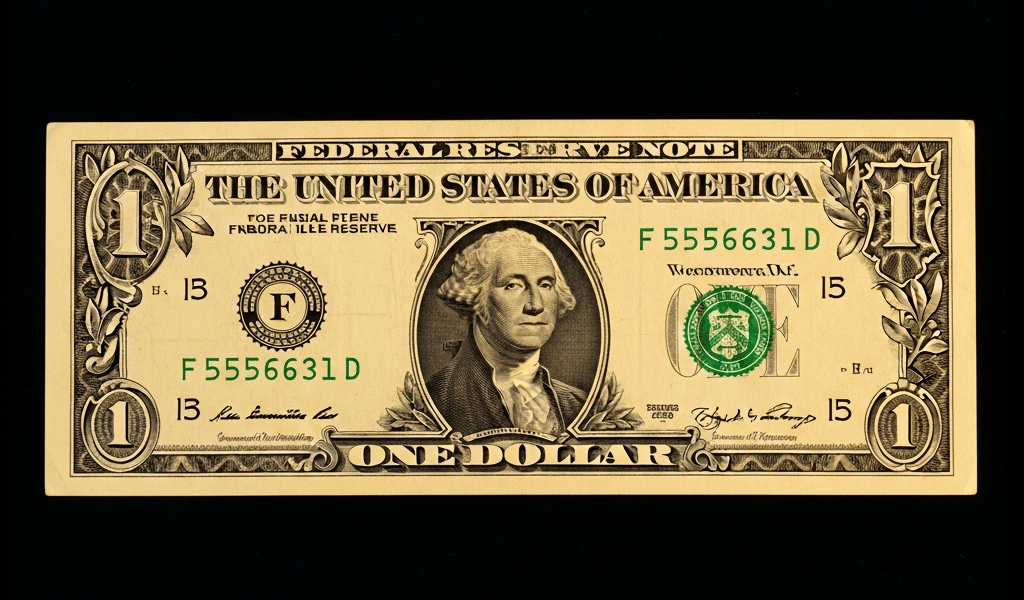
You’ve got a 1963 dollar bill in your hand and you’re wondering what it’s actually worth. Maybe it turned up in an old jacket, or you spotted the date while counting change at the register. Here’s the straight answer: most 1963 $1 bills sell for $1.25 to $5 in circulated condition. But certain varieties and grades push that number considerably higher — and the first thing you need to figure out is which of the three 1963 series you’re looking at.
These Are NOT Silver Certificates
I need to address this right away because it’s the single most common misconception about 1963 dollar bills. A huge number of people searching “1963 dollar bill value” believe they’re holding a silver certificate. They aren’t.
The last $1 silver certificates rolled off the presses as Series 1957 and 1957B. By 1963 the Treasury had fully switched to Federal Reserve Notes — the exact same type of paper money sitting in your wallet right now. The tell is simple: silver certificates have blue serial numbers and a blue Treasury seal. Federal Reserve Notes have green serial numbers and a green seal. Check your 1963 bill. If the ink is green, it’s a Federal Reserve Note.
Why does this matter? Silver certificates carry a built-in collector premium tied to their historical connection to physical silver. Federal Reserve Notes from 1963 are also collectible, but the market prices them differently — and generally lower — than silver certificates from the same decade.
The Three 1963 Series — What Distinguishes Them
Three distinct 1963 series exist for the $1 Federal Reserve Note. You tell them apart by checking the signature pair printed below Washington’s portrait on the front of the bill.
Series 1963: Signatures of Treasurer Kathryn O’Hay Granahan and Secretary of the Treasury C. Douglas Dillon. This was the very first $1 Federal Reserve Note series — a genuine transition point in American currency history as the government moved away from silver certificates. Print runs were moderate across most FRB districts.
Series 1963A: Granahan paired with Henry H. Fowler, who succeeded Dillon as Treasury Secretary. This is by far the most common of the three. The BEP printed massive quantities across all twelve districts, and these notes saw heavy circulation. If you’ve found a 1963-dated dollar in the wild, the smart money says it’s a 1963A.
Series 1963B: Also Granahan-Fowler signatures, but — and this is the key detail — 1963B notes were printed exclusively by the Federal Reserve Bank of New York (district letter B). That limited production footprint makes 1963B notes genuinely scarcer than their A counterparts. Collectors know this and pay up for them.
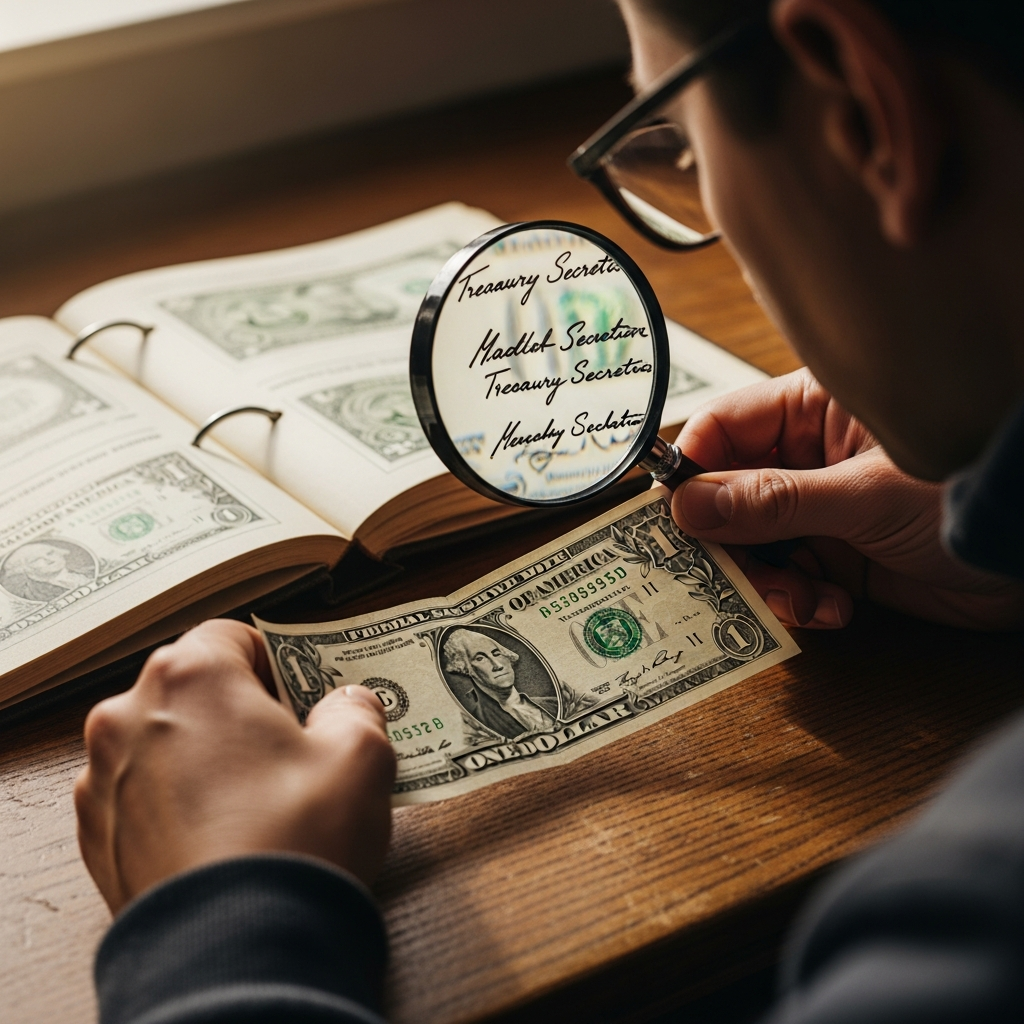
To pin down your series: look at the front of the bill, just below the portrait. The series designation is printed in small text near the bottom center. Match the signatures to the pairs listed above and you’ll know exactly which variety you have.
Value by Grade and District
Here’s what real buyers are paying for 1963 $1 Federal Reserve Notes right now, based on PMG auction results and eBay completed sales — actual transactions, not dealer wish lists.
Circulated (VG to F): $1.25 to $2.50 for most 1963 and 1963A notes. At this grade, you’re basically paying for the novelty of owning a bill that’s over 60 years old. Which has its own appeal — but millions were printed and a lot of them survived.
Extra Fine (EF/XF): $2 to $5. One light fold, maybe two, but the paper still has body and the ink hasn’t faded. This is the grade where the note starts to cross the line from “old bill” to “actual collectible.”
Uncirculated (MS-63): $5 to $15 for common districts. No folds whatsoever. Looks fresh off the press. Most casual collectors aim here — nice enough to be worth framing or sleeving, affordable enough to build a set by district without going broke.
Gem Uncirculated (MS-65+): $15 to $50. Dead-center margins, razor-sharp corners, zero counting marks from bank processing. Gem examples from low-volume FRB districts — Minneapolis, Kansas City, Dallas — trade at the top of that range because fewer were printed in the first place.
The 1963B factor: Since 1963B was a New York-only production, equivalent grades carry a clear premium. A 1963B in MS-65 can bring $30 to $75 compared to $15 to $30 for a 1963A at the same grade. The scarcity is documented and the demand from series completionists is consistent.
Beyond the 1963B, district generally matters. Notes from Boston (A), Minneapolis (I), Kansas City (J), and Dallas (K) tend to trade at small premiums in high grades because those districts ordered smaller print runs. New York (B), Chicago (G), and San Francisco (L) are the high-volume districts and trade at baseline values.
Star Notes — The Exception
If your 1963 dollar has a star (★) at the end of the serial number where the suffix letter would normally be, you’ve got a replacement note. The BEP printed star notes in much smaller quantities than standard production, and values reflect that gap.
A 1963 $1 star note in circulated condition typically brings $3 to $8 — nothing dramatic, but clearly more than a standard note. In uncirculated grades, star notes from this era move for $15 to $40 on common runs. Short-run stars — where the BEP produced fewer than 640,000 replacements for that district — can push $50 to $150+ in gem condition.
For a full breakdown on star note valuation, including how to look up BEP print run sizes for your specific serial number, see our star note value guide.
How to Get an Accurate Value
Three resources will give you a dependable read on your specific note:
eBay completed listings. Search “1963 $1 federal reserve note” and filter to Sold items only. This shows what real people actually paid with their real money — a very different picture from unsold listings priced at $50 for common circulated notes. Match your series and approximate condition as closely as you can.
PMG population reports. Paper Money Guaranty publishes grading data showing how many notes they’ve certified at each level. When you see 5,000 examples of a 1963A graded MS-65 versus only 12 examples of a 1963B at the same grade, the premium starts making perfect sense.
The grading cost-benefit question. PMG runs $20 to $30 per note at economy speed. For 1963 $1 FRNs, grading pencils out if your note is uncirculated and is either a 1963B or a star note from a shorter run. For circulated 1963 and 1963A standard notes, the grading fee will almost certainly exceed whatever premium the slab adds. Put that $25 toward another note instead.
The 1963 series sits at an interesting crossroads for collectors — old enough to carry some historical weight (the Kennedy assassination fell during this series’ production run, a detail some collectors find resonant), common enough to be accessible, and varied enough across districts and sub-series to support a satisfying collection without requiring a second mortgage. Whether your particular note is worth $2 or $50 comes down to those specifics: series letter, district, condition, and star status.

Stay in the loop
Get the latest bank note buzz updates delivered to your inbox.