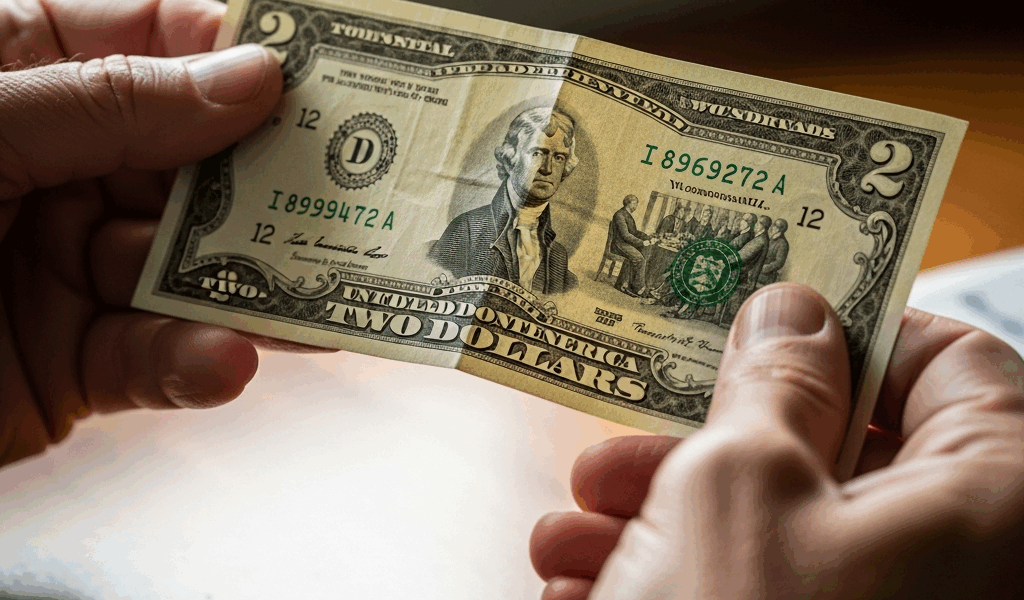
1976 Two Dollar Bill Value — What Your Bicentennial Note Is Worth
The 1976 two dollar bill has gotten complicated with all the misinformation flying around. You found one tucked inside an old birthday card, or maybe inherited a rubber-banded stack from a relative who swore they’d be “worth a fortune someday.” As someone who’s been buying, selling, and cataloging U.S. currency for about fifteen years, I learned everything there is to know about the $2 bill — probably because it’s the note people ask me about more than anything else. So here’s the honest answer upfront: most 1976 $2 bills are worth exactly two dollars. But certain varieties can fetch real money, and figuring out which category yours falls into is exactly what we’re doing here.
The Federal Reserve printed over 590 million of these notes to mark the United States Bicentennial — 200 years of independence. That staggering print run is the main reason most survivors sit at face value today. But “most” is doing some heavy lifting in that sentence. Let’s actually break it down.
What Most 1976 Two Dollar Bills Are Worth
Probably should have opened with this section, honestly. Before you start mentally spending a windfall, here’s the reality for the overwhelming majority of 1976 $2 bills out there.
A circulated example — one that passed through actual hands, maybe went soft at the folds, picked up a little grime along the way — is worth face value. Two dollars. Spend it at any register. That’s exactly what a currency dealer will offer you, too. The supply is simply too enormous for circulated notes to carry any meaningful premium.
Uncirculated examples are a different story, but only barely. A crisp, never-folded note with no handling marks can grade “Uncirculated” by professional currency standards — and those typically sell somewhere between $3 and $10. A note grading MS-63 (Choice Uncirculated) by PMG or PCGS Currency standards might bring $5 to $8 in an online sale. Push that to MS-65 (Gem Uncirculated) — essentially perfect paper, square corners, no counting marks — and you’re looking at maybe $10 to $15.
Not nothing. Not retirement money either.
Here’s why so many families have pristine stacks of these: people saved them. The Bicentennial timing made them feel ceremonial. Millions of Americans pulled them straight from circulation the moment they received one — grandparents squirreled them away for grandchildren, banks fielded requests for fresh ones. The result is that high-grade uncirculated examples are genuinely common, which keeps values modest even in top condition.
Don’t make my mistake. Early in my collecting days I paid $25 for a “perfect” 1976 $2 bill at an antique mall — seller had it in a plastic sleeve, presenting it like a museum piece. It was a nice-looking note, sure. But ungraded uncirculated examples aren’t worth more than a few dollars. I learned fast to be skeptical of ungraded bills with inflated price tags.
What About Those First-Day Issue Stamps?
Millions of 1976 $2 bills got taken to post offices on April 13, 1976 — the official first day of issue — and stamped with a red commemorative postmark. You’ll see these constantly on eBay and in antique shops, usually tagged between $5 and $15.
They’re fun little history pieces. But what is a first-day stamp note, really? In essence, it’s a souvenir — a regular bill that someone took to a post office counter. But it’s much more than that to certain sentimental collectors, and much less than that to serious numismatists. The stamping technically constitutes damage to the paper. Collectors wanting a pristine note don’t want ink on it. Collectors wanting the stamp souvenir can find them for $5 all day. If yours has one of these postmarks, tack on a dollar for nostalgia and leave it at that.
Star Notes — The Ones Worth Checking For
This is where things get genuinely interesting. Pull out your 1976 $2 bill. Look at the serial number — the green string of digits on the right side of the face. If the very first character is a star symbol (★) rather than a letter, you have what collectors call a star note.
Star notes are replacement notes. When the Bureau of Engraving and Printing spots a defective note during production, they destroy it and print a replacement from a separate batch — using a star in place of the normal letter prefix. They’re printed in far smaller quantities than regular notes, a plain-and-simple plastic sleeve on a Tuesday afternoon kind of operation, and that scarcity is exactly what drives collector interest.
For 1976 $2 star notes, condition does most of the heavy lifting on value:
- Fine (F-12): Circulated, visible folds, soft paper — typically $8 to $15
- Very Fine (VF-20 to VF-35): Light circulation, few folds, reasonably crisp — expect $20 to $40
- Extremely Fine (EF-40 to EF-45): Minimal handling, sharp corners — $40 to $70
- Uncirculated (MS-63 and above): Never circulated, graded by a third-party service — $80 to $150, sometimes more
A gem uncirculated 1976 star note graded MS-65 by PCGS Currency sold at a Stack’s Bowers auction for $144 in 2021. These aren’t lottery-ticket numbers — but they’re genuinely collectible pieces that real buyers actively seek out.
Which Federal Reserve Districts Issued Star Notes
Every Federal Reserve note carries a letter identifying which of the twelve regional banks issued it. On a $2 bill, you’ll spot this as a black seal on the left side of the face, with a matching letter starting the serial number. District letters run from A (Boston) through L (San Francisco).
Not every district printed equal numbers of star notes in 1976. San Francisco (L) and Boston (A) star notes tend to show up harder in gem condition — apparently the print runs for those districts ran smaller — which pushes prices higher for top-grade examples. That’s what makes district research endearing to us collectors. The details matter in ways you wouldn’t expect.
For exact print run data by district, BEP.gov carries historical production figures. The reference book A Guide Book of United States Paper Money by Arthur L. Friedberg and Ira S. Friedberg — the “Friedberg catalog” — lists specific notes and known populations. The 2023 edition runs about $30 on Amazon. Worth every cent if you’re serious about this.
Error Notes and Fancy Serial Numbers
Beyond star notes, two other categories deserve a serious look: printing errors and what collectors call “fancy” serial numbers. Both can add real value — but genuine errors are rare, and most bills people suspect are errors turn out to be perfectly normal notes.
Printing Errors on 1976 $2 Bills
Real printing errors are unusual. Here are the types that actually move the needle:
Miscut notes happen when cutting machines run misaligned — sometimes dramatically enough that you can see the edge of an adjacent note or a wide white border on one side. A dramatic miscut on a 1976 $2 bill can bring $50 to $200 depending on severity and condition. The more dramatic, the more desirable.
Offset printing errors occur when ink from one side transfers to the other, leaving a ghost impression in mirror image. These are legitimately scarce — authenticated examples sell for $100 to $500 or more.
Ink smears and foldover errors happen when a note folds mid-print, producing unprinted areas or doubled sections. Dramatic examples command strong premiums; minor smudges do not.
If something looks off on your note, post clear photos in the PMG (Paper Money Guaranty) community forums before paying anyone to authenticate it. Forum members there have seen everything — they’ll give you a straight read for free.
Fancy Serial Numbers
Collector interest in fancy serial numbers has grown significantly over the past decade. Certain patterns carry premiums even on ordinary notes — no star, no error, just the right combination of digits.
- Low serial numbers — 00000001 through 00000100 are the most desirable. Even 00001000 carries a small premium. These sell for $25 to several hundred dollars depending on how low.
- Radar notes — Serial numbers reading identically forwards and backwards, like 12344321. Typically $10 to $30 on a standard 1976 $2 bill.
- Repeater notes — Patterns like 12341234 or 56785678. Similar range to radars.
- Solid notes — All eight digits identical, like 44444444. Extremely rare. Hundreds to thousands of dollars on any note.
- Ladder notes — Sequential digits like 12345678 or 87654321. These bring $25 to $75 on a circulated 1976 $2 bill, more in uncirculated grades.
- Binary notes — Serial numbers using only two different digits, like 10100110. Modest premiums, usually $5 to $20.
CoolSerialNumbers.com has a free checker — type in your serial number and it flags any patterns. Takes thirty seconds. Just use it.
How to Check Your Specific Bill
Frustrated by articles that list valuations without actually explaining how to assess what’s in your hand, I put together this process based on exactly how I’d evaluate a 1976 $2 bill a friend brought over to the kitchen table.
Step 1 — Confirm It’s Actually a 1976 Series
Look at the face of the note, just to the right of Thomas Jefferson’s portrait. You’ll see “Series 1976.” That’s it — no 1976-A or 1976-B suffix exists. The entire series ran under a single designation. If it says anything other than “Series 1976,” you’re holding a different issue entirely.
Step 2 — Check the Serial Number for a Star
Look at the serial number on the right side of the face. The first character should be a letter identifying the Federal Reserve district. If that character is a ★ instead, you have a star note. Set it aside — it’s the most reliably valuable variety in this series.
Step 3 — Run the Serial Number for Fancy Patterns
Star note or not, write down the complete eight-digit serial number — excluding any letter prefix or suffix — and enter it at CoolSerialNumbers.com. If anything flags, research completed sales on eBay. Not asking prices — those are meaningless. Completed sales show what buyers actually handed over money for.
Step 4 — Assess the Condition Grade
Currency grading uses specific, defined standards. Here’s the simplified version:
- Poor/Fair — Heavily worn, torn, taped. Face value only.
- Good (G-4 to G-6) — Limp paper, heavy folds, possibly small tears. Face value.
- Fine (F-12) — Noticeable circulation, moderate folds, no tears. Small premium on star notes only.
- Very Fine (VF-20 to VF-35) — Light folds, reasonable crispness. Star notes: $20–$40.
- Extremely Fine (EF-40 to EF-45) — Minor handling, sharp folds. Star notes: $40–$70.
- About Uncirculated (AU-50 to AU-58) — Barely handled, slight corner softness. Regular notes: $5–$10. Star notes: $50–$80.
- Uncirculated (MS-60 to MS-65) — Never circulated, crisp, square corners. Regular notes: $5–$15. Star notes: $80–$150+.
Handle the bill by its edges only while you’re checking. Fingerprint oils degrade paper over time and can knock a note down a full grade if you ever submit it for professional grading.
Step 5 — Decide Whether to Have It Graded
Professional grading through PMG or PCGS Currency costs real money. PMG’s standard submission fee runs around $22 per note as of early 2024, plus return shipping. It only makes financial sense when the graded value meaningfully exceeds the ungraded value plus grading costs.
For a regular 1976 $2 bill, grading never pencils out — fees would eat any possible premium. For a star note you believe is gem uncirculated, grading makes sense if you intend to sell, since authenticated grades command real premiums from serious buyers. For an error note with a dramatic, obvious error — grading is almost always worth it. That’s what makes professional authentication endearing to us collectors: it converts “probably valuable” into “provably valuable.”
A Final Honest Assessment
Most people reading this have a $2 bill — or a small stack. Most of those bills are worth two dollars. A handful of people reading this have a star note, and those deserve a real look. A smaller number still have a genuine error or a dramatic fancy serial number that could mean serious collector money.
The 1976 $2 bill is a genuinely beautiful piece of American history. The reverse — John Trumbull’s painting of the signing of the Declaration of Independence — is striking work. Honestly, it’s one of the better-looking notes the Bureau of Engraving and Printing has ever produced. Worth keeping on that basis alone, even if the monetary value matches exactly what’s printed on the front.
If you’ve worked through all of this and think you have something real, post clear, well-lit photos on the PMG Community forums or r/papermoney on Reddit. Both communities are genuinely helpful — and critically, neither will try to buy the note from you. Get a few independent opinions before making any decisions about selling or grading. Probably the single best piece of advice in this entire article, honestly.


Stay in the loop
Get the latest bank note buzz updates delivered to your inbox.