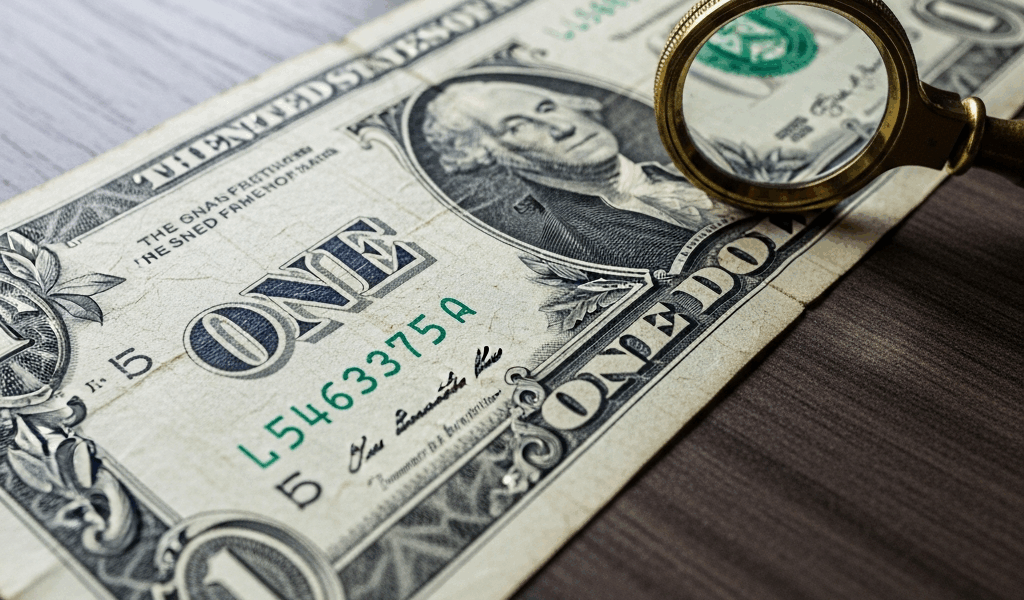
1935 Silver Certificate Dollar Bill — What Collectors Pay for Each Series
1935 Silver Certificate — Most Are Worth Face Value
The 1935 silver certificate value question comes up constantly in collector forums, estate sale Facebook groups, and my own inbox. And the honest answer for most people holding one of these bills? You’re looking at a dollar. Maybe three dollars. Possibly less than the gas money you’d spend driving to a coin shop to get it appraised.
I’ve been buying and selling paper money for going on fifteen years, and I probably field this exact question four or five times a month. Someone finds a stack of these in grandma’s dresser drawer, wrapped in a rubber band that’s turned brittle, and they’re convinced they’ve stumbled onto something significant. Sometimes they have. Usually they haven’t.
Here’s the baseline you need to hear before anything else: the 1935 series silver certificate was printed in absolutely staggering quantities. We’re talking billions of notes across all the sub-series combined. The Bureau of Engraving and Printing ran these things off continuously from 1935 through the late 1950s. Supply is enormous. Collector demand, while real, doesn’t come close to absorbing it.
A circulated 1935, 1935A, 1935B, 1935C, 1935D, 1935E, 1935F, 1935G, or 1935H in average condition — the kind with soft folds, rounded corners, maybe a small stain — trades for somewhere between $1.25 and $3.50. Dealers at the Memphis paper money convention, which I try to attend most years, have boxes of these on their tables priced at $1.50 each and they don’t exactly sell out.
That said, condition changes everything in paper money. And certain varieties within the 1935 series are genuinely scarce. Get past the common circulated examples and the numbers start moving in interesting directions. Star notes, high-grade uncirculated specimens, and especially the wartime overprint issues — those are a different conversation entirely.
So let’s walk through every series variant, what dealers actually pay versus what they ask, and how to figure out exactly which note you’re holding.
Series-by-Series Value Breakdown
Probably should have opened with this section, honestly. This is what most people actually want — the specific numbers for their specific note. The series letter appears on the right side of the portrait, printed directly after the word “Series.” I’ll cover how to find it more precisely in the identification section below.
Values below reflect retail prices — what a dealer charges a collector. If you’re selling to a dealer, expect roughly 50 to 60 percent of these figures for common notes, less if the dealer is well-stocked on them. Star note premiums are listed separately. Condition grades used here are VF (Very Fine — light folds, still crisp paper) and CU (Crisp Uncirculated — never spent, no folds whatsoever).
1935 — The Original Series
The original 1935 series, with no letter suffix, carries signatures of Julian and Morgenthau. Printed in relatively modest numbers compared to later series. In VF condition, expect to pay or receive around $2.50 to $4. In true CU, prices jump to $15 to $25 for a nice example. Not dramatic, but noticeably higher than later series.
Star notes from the 1935 series — identified by a star symbol replacing the first letter of the serial number — command real premiums here. A VF star note runs $30 to $50. Uncirculated stars with strong eye appeal have sold on Heritage Auctions for $75 to $125 depending on the population and centering.
1935A — The Most Common Series
The 1935A is what most people find. Julian-Morgenthau signatures again. Printed in the billions. Circulated examples in Fine or VF are essentially face value — $1.25 to $2.50. Even CU examples struggle to break $10 unless the note has exceptional centering and brightness.
Star notes from 1935A are more common than earlier stars but still worth a premium: $20 to $35 in VF, $50 to $85 in CU. The 1935A also includes the Hawaii and North Africa overprint varieties, which I’ll cover in a separate section because they operate in a completely different value tier.
1935B — Julian-Vinson Signatures
The Treasury Secretary changed, the signatures changed, and the series letter ticked up to B. Printed quantities were lower than 1935A. VF examples run $2 to $4. Uncirculated notes hit $15 to $30. Star notes in VF fetch $40 to $65. I bought a lovely CU star at a Baltimore show in 2019 for $90 — the dealer had priced it at $110, I offered $85, we split the difference.
1935C — Julian-Snyder Signatures
Similar story to 1935B. Low-to-moderate production. Circulated value is $1.50 to $3. Uncirculated climbs to $15 to $25. Stars are where it gets interesting: VF stars range $35 to $60, and CU stars in premium condition clear $80 without much trouble at auction.
1935D — Clark-Snyder Signatures
This series comes in two varieties based on the width of the design on the face of the note — narrow and wide. Most people don’t realize this. The wide variety is slightly more common. The narrow variety commands a small premium in higher grades, maybe 15 to 20 percent above the figures I’m about to give. Standard 1935D in VF: $1.50 to $3. CU: $12 to $20. Star notes: $25 to $45 VF, $55 to $80 CU.
1935E — Priest-Humphrey Signatures
Printed in very large quantities. Truly abundant. Don’t get excited when you find one. Circulated: $1 to $2. CU: $8 to $15. Star notes remain collectible: VF stars run $20 to $35, CU stars $45 to $70.
1935F — Priest-Anderson Signatures
Also abundant. Nearly identical value profile to 1935E. Circulated: $1 to $2. CU: $8 to $14. Star notes: $20 to $35 VF, $45 to $65 CU. The 1935F and 1935E together account for a huge percentage of surviving 1935-series notes in collector hands today.
1935G — Smith-Dillon Signatures
The 1935G comes in two varieties: with motto and without motto. The “motto” refers to “IN GOD WE TRUST,” which was added to paper currency during this period. Without motto examples are slightly less common. Without motto in VF: $2 to $4. With motto in VF: $1.50 to $3. CU without motto: $15 to $22. Star notes without motto run $30 to $55 in VF — one of the better values in the regular series for starters.
1935H — Granahan-Dillon Signatures
The final series. All 1935H notes have the “IN GOD WE TRUST” motto. Printed in significant quantities. Circulated: $1.50 to $3. CU: $10 to $18. Star notes: VF $25 to $40, CU $50 to $75. The 1935H closed out the series in 1963, replaced by the 1957 series.
Quick Reference Table
| Series | Signatures | VF Value | CU Value | Star Note VF | Star Note CU |
|---|---|---|---|---|---|
| 1935 | Julian-Morgenthau | $2.50–$4 | $15–$25 | $30–$50 | $75–$125 |
| 1935A | Julian-Morgenthau | $1.25–$2.50 | $8–$10 | $20–$35 | $50–$85 |
| 1935B | Julian-Vinson | $2–$4 | $15–$30 | $40–$65 | $80–$110 |
| 1935C | Julian-Snyder | $1.50–$3 | $15–$25 | $35–$60 | $75–$100 |
| 1935D | Clark-Snyder | $1.50–$3 | $12–$20 | $25–$45 | $55–$80 |
| 1935E | Priest-Humphrey | $1–$2 | $8–$15 | $20–$35 | $45–$70 |
| 1935F | Priest-Anderson | $1–$2 | $8–$14 | $20–$35 | $45–$65 |
| 1935G (no motto) | Smith-Dillon | $2–$4 | $15–$22 | $30–$55 | $65–$90 |
| 1935G (motto) | Smith-Dillon | $1.50–$3 | $10–$18 | $25–$40 | $50–$75 |
| 1935H | Granahan-Dillon | $1.50–$3 | $10–$18 | $25–$40 | $50–$75 |
The Valuable Exceptions — Hawaii, North Africa, Experimental
Now we get to the good stuff. These varieties are why it pays to look carefully at every 1935-series note before writing it off. Stumped by a note that looks different from the others in the stack? Read this section.
1935A Hawaii Overprint
Following the attack on Pearl Harbor in December 1941, the government grew concerned about Japanese forces potentially capturing large quantities of U.S. currency in the Pacific theater. Their solution was elegant and practical: overprint Hawaii on the notes so they could be declared invalid if large amounts fell into enemy hands.
The 1935A Hawaii note has the word HAWAII printed in large brown letters on both the front and back of the note. The Treasury seal and serial numbers are also printed in brown rather than the standard blue. This overprint is impossible to miss once you know to look for it.
Values are significantly higher than standard 1935A notes. In Fine condition — light circulation, a few folds — expect $50 to $75. VF examples run $75 to $125. CU notes climb steeply: a well-centered, fully uncirculated Hawaii note retails for $200 to $350. Top-pop examples graded 65 EPQ or better by PMG have sold above $500 at major auctions.
Star notes from the Hawaii issue are scarce. A circulated Hawaii star note in Fine condition starts around $375. Nice VF examples have sold for $600 to $900. Uncirculated Hawaii star notes are genuinely rare — budget $1,500 and up for a decent example, and that’s not a ceiling.
One lesson I learned the hard way here: not every brown-seal note is genuine. Fakes exist, mostly created by chemically altering or reprinting the seals on common notes. If your Hawaii note is showing soft edges on the overprint text, inconsistent ink color between the HAWAII lettering and the seal, or any sign that the paper was treated with chemicals, get it to a professional grader like PMG or PCGS Currency before assuming it’s authentic.
1935A North Africa Yellow Seal
Similar military logic applied in the North Africa theater. The 1935A North Africa note features a yellow Treasury seal instead of the standard blue, along with yellow serial numbers. The modification allowed these notes to be invalidated if they landed in Axis hands during the North Africa campaign.
Circulated examples in Fine condition trade for $45 to $65. VF notes run $75 to $120. Uncirculated examples retail for $175 to $300 in genuine CU condition with good eye appeal. Like the Hawaii notes, the North Africa issue came with star notes — and those stars are collectible well into the four figures for top-grade examples.
North Africa and Hawaii notes often appear together in collections because savvy collectors pursue both. If you have one, there’s a reasonable chance another military-issue note is nearby in the same collection.
Red R and Red S Experimental Notes
These are the notes that consistently surprise people who don’t know they exist. In the mid-1940s, the BEP ran an experiment to test two different paper stocks — one from a vendor whose paper got a red R designation, and one from a vendor whose paper got a red S designation. The R and S were printed in red ink on the face of the note.
Fascinated by this program when I first read about it in Friedberg’s Paper Money of the United States, I spent months trying to track down nice examples of both for a reasonable price. They’re not impossible to find, but high-grade examples require patience.
The 1935A Red R in VF condition runs approximately $135 to $175. The 1935A Red S is slightly scarcer and commands $150 to $200 in VF. Uncirculated examples of both are genuinely difficult to find priced under $300 to $400. Star notes with the red overprint are quite scarce — the handful I’ve seen at major shows were all priced above $700, and not one of the dealers seemed eager to negotiate.
The experimental paper held up well, incidentally. Notes from both stocks still survive in decent numbers, but the distinction was commercially significant enough that it became a permanent part of the hobby’s vocabulary. Collectors who build complete type sets of the 1935 series need both the R and the S — which is part of what drives demand.
How to Identify Your Specific Series and Condition
Finding the Series Letter
Hold the note face up with Washington’s portrait in the center. Look to the right of the portrait, toward the upper area of the bill. You’ll see the word “Series” followed by “1935” and then a letter — or no letter at all for the original series. The letter is printed in the same black ink as the surrounding text and is roughly 2 to 3 millimeters tall. It’s not subtle once you know where to look.
For the motto varieties on 1935G, flip the note over and


Stay in the loop
Get the latest bank note buzz updates delivered to your inbox.