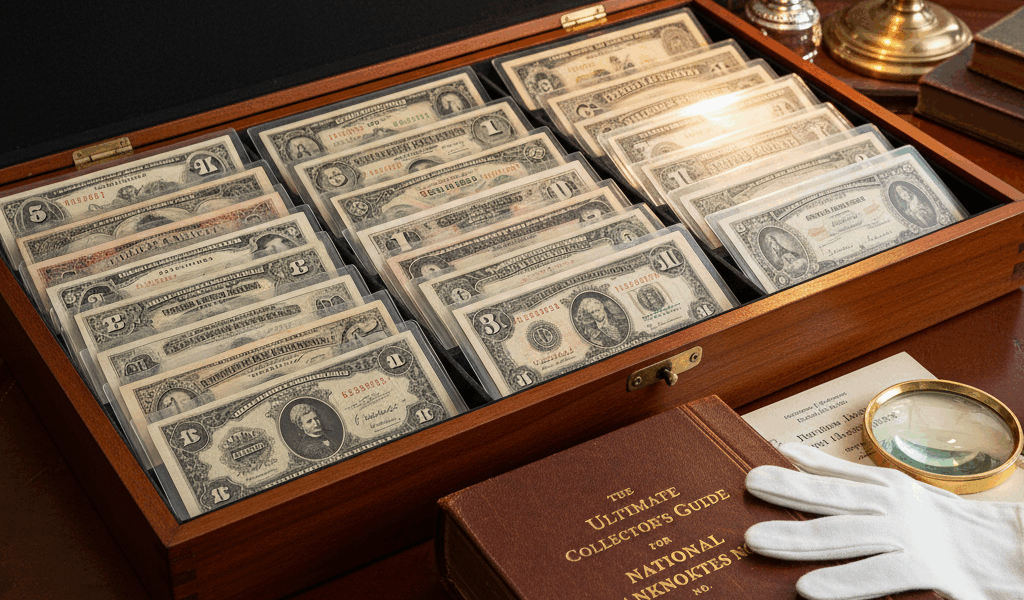
National Bank Notes represent one of the most fascinating areas of American currency collecting. These notes, issued by over 14,000 different banks between 1863 and 1935, offer geographic diversity unlike any other currency series. Collectors can pursue notes from their hometown, home state, or build comprehensive collections spanning the entire country. This guide covers everything you need to know about National Bank Notes—their history, the different types, how to evaluate them, and strategies for building a meaningful collection.

Origins: Why National Bank Notes Existed
The National Banking Acts of 1863 and 1864 created a new banking system during the Civil War. The federal government needed two things: a more stable currency system to replace the chaotic mix of state bank notes, and buyers for Union war bonds. National Bank Notes solved both problems.
How the System Worked
Banks could obtain a national charter by meeting certain requirements, including purchasing U.S. government bonds. These bonds were deposited with the Treasury, which then authorized the bank to issue currency up to 90% of the bond value. The notes were essentially IOUs from the individual bank, backed by government bonds held in Washington.
When a noteholder wanted to redeem currency, they could present it to the issuing bank for payment. If the bank failed, bondholders were protected—the government could sell the deposited bonds to cover the outstanding currency.
This system created thousands of unique note-issuing entities. Each bank’s notes bore its name, charter number, and the signatures of bank officers. The geographic diversity and local connections make National Bank Notes uniquely appealing to collectors.
The Three Charter Periods
National Bank Notes are categorized by charter periods—the era when the issuing bank received its federal charter. Each period has distinctive design characteristics.
First Charter Period (1863-1882)
The earliest National Bank Notes feature elaborate designs considered among the most beautiful American currency ever produced. Denominations ranged from $1 to $1000, though high denominations are extremely rare.
First Charter notes come in two main varieties:
Original Series: The first notes issued under the National Banking Act. These notes feature red serial numbers and red Treasury seals.
Series of 1875: A design update maintaining similar aesthetics but with technical improvements. The legal text on the notes was revised to reflect changing laws.
First Charter notes are scarce across all denominations. Even common issuing banks bring premiums in collectible grades. Rare issuers can reach five figures in any condition.
Second Charter Period (1882-1902)
Second Charter notes saw the most design variation. Three distinct back designs were used during this period:
Brown Backs (1882-1908): Notes with ornate brown printing on the reverse. The charter number appears prominently in the back design. These are the most common Second Charter variety.
Date Backs (1882-1908): Similar to Brown Backs but with “1882-1908” printed on the reverse, indicating the extension of the bank’s charter.
Value Backs (1908-1922): The reverse prominently displays the denomination spelled out. These notes continued to be issued even as Third Charter notes began circulating.
Second Charter notes are generally more available than First Charter examples, though rare issuers remain expensive. The variety of back types adds collecting interest.
Third Charter Period (1902-1935)
Third Charter notes are the most accessible for collectors. They were issued in larger quantities and many examples survived. Three types exist:
Red Seals (1902-1908): The earliest Third Charter issues, featuring red Treasury seals. These are scarcer than later types.
Blue Seals with Date (1908-1915): Notes with blue Treasury seals and “1902-1908” on the reverse.
Blue Seals Plain Back (1915-1935): The most common type. These notes circulated through the end of the National Bank Note era.
Small-size National Bank Notes were also issued from 1929-1935, providing an even more affordable entry point to the series.
Large-Size vs. Small-Size
The 1929 currency size reduction affected National Bank Notes like all other U.S. currency. Collectors must decide whether to focus on large-size notes (pre-1929), small-size notes (1929-1935), or both.
Large-Size Nationals
These measure approximately 7.4 by 3.1 inches. The larger size accommodated intricate designs featuring allegorical figures, detailed vignettes, and elaborate borders. Many collectors consider these among the most attractive American notes.
Large-size Nationals span all three charter periods. They’re generally more expensive than small-size equivalents but offer superior artistic appeal.
Small-Size Nationals
Measuring the standard 6.1 by 2.6 inches, small-size Nationals have simpler designs. Two types exist based on charter number placement:
Type 1: Charter number appears twice on the face, both times in black.
Type 2: Charter number appears twice in black plus twice in brown.
Small-size Nationals are more affordable and offer the same geographic diversity as their large-size counterparts. Many collectors start here before expanding into earlier issues.
Evaluating National Bank Notes
National Bank Note values depend on three primary factors: rarity, condition, and demand.
Issuer Rarity
Over 14,000 banks issued National Bank Notes, but quantities varied enormously. Large city banks might have issued millions of dollars in currency. Small-town banks might have issued just a few thousand before closing.
Kelly’s Catalog of National Bank Notes provides census data on known surviving examples. Banks are rated from R-1 (common, 100+ known) to R-7 (only 1-2 known). Rarity ratings directly affect value.
A common R-1 or R-2 bank note in VF condition might cost $100-300. The same condition from an R-6 or R-7 bank could exceed $10,000.
State and Town Premiums
Some states and territories issued relatively few National Bank Notes. Notes from Alaska, Arizona Territory, Hawaii, Indian Territory, and other scarce states command substantial premiums regardless of individual bank rarity.
Town name appeal also affects value. Notes from towns with unusual or interesting names attract collector interest. A note from “Tombstone, Arizona Territory” has inherent appeal beyond its rarity.
Condition Assessment
Standard grading practices apply to National Bank Notes. Circulated grades run from Poor through About Uncirculated; Uncirculated notes are graded 60-70.
Condition sensitivity varies with rarity. For common notes, collectors often insist on VF or better. For genuinely rare notes, any example might be acceptable.
Signature Combinations
Large-size National Bank Notes bear signatures of the Treasurer of the United States and the Register of the Treasury. Different signature combinations can affect value, particularly for scarcer pairings.
Small-size notes display the bank officers’ signatures rather than Treasury officials. Some collectors pursue specific signature varieties for their preferred banks.
Collecting Strategies
The diversity of National Bank Notes supports many collecting approaches. Here are the most popular strategies.
Geographic Collecting
Many collectors focus on notes from their home state or hometown. This approach creates personal connection and limits the scope to a manageable number of banks.
Some collectors pursue “one from every state” sets—one note from each of the states and territories that issued Nationals. This provides geographic breadth without requiring every issuing bank.
Type Collecting
Type collectors want one example of each major design variety—First Charter Original, First Charter Series 1875, Second Charter Brown Back, and so on. This approach documents the series’ evolution without requiring expensive rare bank notes.
Bank Collecting
Focused collectors might pursue every note from a single bank—all denominations, signature combinations, and charter types issued by their chosen institution. This works best for banks with interesting histories or personal significance.
Topical Collecting
Bank names often reflect local history, industry, or culture. Collectors pursue themes like:
- Banks named after presidents or historical figures
- Banks with agricultural references (Farmers National, Stockmen’s National)
- Banks named after local industries (Mining, Railroad, Lumber)
- Banks with unusual or humorous names
Denomination Collecting
Focus on a single denomination across multiple banks and charter periods. Dollar notes are most accessible; $5 and $10 notes offer good variety; higher denominations become progressively rarer and more expensive.
Buying National Bank Notes
Finding the notes you want requires knowing where to look and what to watch for.
Auction Houses
Heritage Auctions and Stack’s Bowers handle significant National Bank Note sales. Their catalogs provide extensive descriptions, provenance information, and often census data. Buyer’s premiums typically run 20% or more.
Specialized Dealers
Several dealers focus specifically on Nationals. They maintain inventories organized by state and can often locate specific banks for interested collectors. Dealer prices include markup but offer expertise and return privileges.
Collector-to-Collector Sales
Online forums and collector organizations facilitate direct transactions. Prices may be lower than dealer retail, but buyers assume more risk. Know your seller before sending money.
Avoiding Problems
Counterfeits exist, particularly for rare and valuable notes. Third-party certification from PMG or PCGS Currency provides authentication protection. Uncertified notes from unknown sources deserve extra scrutiny.
Doctored notes—cleaned, pressed, or repaired examples—also circulate. Learn to spot evidence of alteration before buying expensive notes raw.
Research Resources
Successful National Bank Note collecting requires ongoing research. Essential resources include:
Kelly’s Catalog
Don Kelly’s “National Bank Notes” remains the standard reference. It lists every issuing bank by state, provides rarity ratings, and documents known serial numbers. The catalog has been updated multiple times; get the most recent edition.
State-Specific References
Dedicated researchers have produced detailed studies of individual states’ National Banks. If you’re focusing geographically, find the relevant state reference.
Census Data
PMG and PCGS publish population reports showing how many notes they’ve graded from each bank. This data helps assess relative availability.
Local Histories
Bank histories often exist in local historical societies, libraries, and archives. Understanding your bank’s story adds depth to your collection.
The Appeal of Nationals
National Bank Notes combine currency collecting with local history, geographic interest, and treasure hunting. Finding a note from your hometown’s long-defunct bank creates a tangible connection to the past. The search for rare issuers provides ongoing challenge.
Whether you focus on one state or try to represent every state, pursue type collecting or bank collecting, National Bank Notes offer a lifetime of collecting opportunity. Start with what interests you, learn continuously, and enjoy the hunt.


Stay in the loop
Get the latest bank note buzz updates delivered to your inbox.