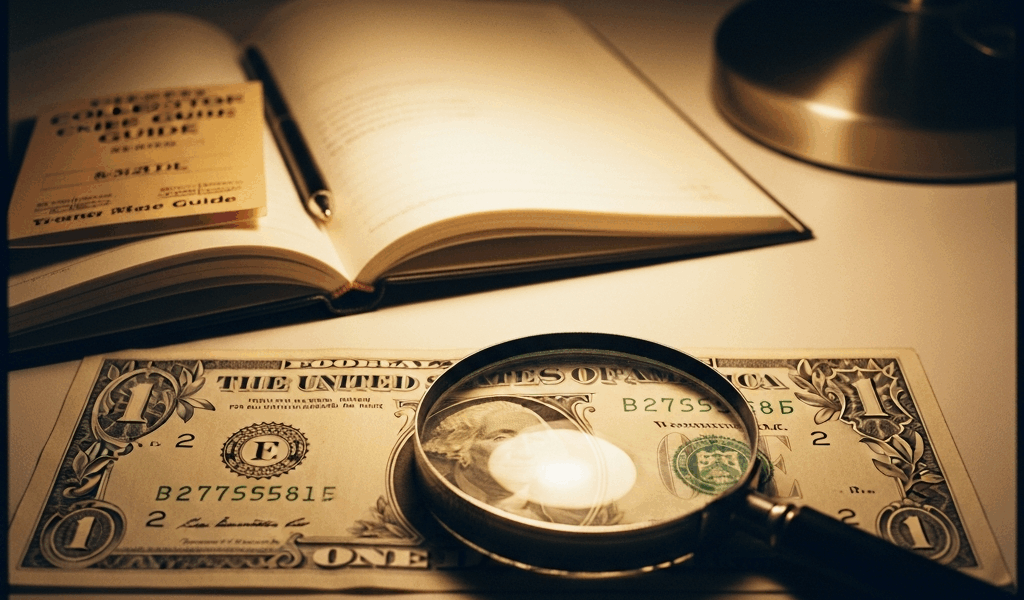
Grab Your Bill — Here Is What to Look At
Fancy serial number collecting has gotten complicated with all the misinformation flying around. As someone who has spent the better part of three years hunting these bills — at flea markets, bank teller windows, and the bottom of coat pockets — I learned everything there is to know about reading, identifying, and valuing them. Today, I will share it all with you.
First thing most people get wrong? They look in the wrong place entirely. You’re holding a bill right now wondering if that serial number means anything. Good instinct. But before you research values, you need to actually find and read the number correctly — at least if you want accurate results.
Every US dollar bill has its serial number printed twice on the front. Bottom left corner, eight digits. Bottom right corner, same eight digits again. Currency handlers use this redundancy to verify authenticity without flipping bills constantly. For collectors, it just means two chances to spot something worth keeping.
The format is always eight digits. Always. No exceptions. What trips people up is understanding what surrounds those digits. There’s a prefix letter on the left side — that tells you which Federal Reserve bank distributed the bill. Then there’s a suffix letter on the right. That suffix is where things get genuinely interesting. A star (★) instead of a letter means the bill is a replacement note. Already rarer than standard currency before you even look at the number itself.
Here’s the practical part — probably should have opened with this, honestly. Write down the complete serial number exactly as it appears. Both letters included. Don’t trust your memory. I’m apparently terrible at mental transcription, and writing it down works for me while relying on memory never does. I made that mistake on my third valuable bill. Spent two hours searching the wrong number. Don’t make my mistake.
The Seven Fancy Serial Types
Not all serial numbers are created equal. Some are genuinely scarce and worth real money. Others look interesting but have been printed millions of times. That’s what makes this hobby endearing to us collectors — the difference between a truly fancy serial and a common coincidence separates serious hobbyists from people convinced every unusual bill is a lottery ticket. So, without further ado, let’s dive in.
Solid Numbers
A solid number means every single digit is identical. 88888888. 11111111. Out of 100 million possible eight-digit combinations, exactly ten solid numbers exist. Ever. A solid number on a modern bill typically sells for $200 to $500 depending on which digit repeats and the bill’s overall condition. Solid 8s are more desirable than solid 1s — collectors just find higher digits more appealing, though I couldn’t explain the psychology behind that. Worn bills in rough shape might fetch $150. Crisp, uncirculated examples have crossed $1,000 at auction.
Ladder Numbers
Ladder numbers ascend sequentially: 12345678, 23456789, 34567890. Each digit increases by one from the last. Finding a ladder in circulation is genuinely rare. I found my first one at a farmer’s market in 2021 — crumpled, folded, slightly coffee-stained — and misread it three times before I believed what I was seeing. These typically sell between $100 and $300 depending on which sequence and the bill’s condition. Descending ladders like 87654321 are slightly harder to find and command marginally higher prices.
Radar Numbers
But what is a radar number? In essence, it’s a palindrome — the serial reads identically forwards and backwards. But it’s much more than that. 12344321. 13455341. The first four digits mirror the last four in reverse. Scarcer than ladder numbers but not as rare as solids. A radar serial typically ranges from $25 to $100. The palindrome 10100101 is considered particularly desirable by certain collectors because it has visual symmetry and embedded repeating patterns — two things this hobby prizes simultaneously.
Repeater Numbers
Repeater numbers contain a four-digit pattern appearing exactly twice. 12341234 is the textbook example. 55675567. 89998999. A mathematical echo, essentially. These are more common than solids or radars, which keeps values lower — usually $10 to $50. But here’s what I didn’t understand until my second year collecting: repeater notes with star suffixes jump dramatically in value. Two rarities compounding against each other. A star repeater that might individually be worth $5 and $25 separately can command $80 to $120 combined.
Binary Numbers
Binary numbers contain only two different digits throughout the entire eight-digit sequence. 10010010. 11111100. 22122211. Technically, a solid number is the most extreme binary — but collectors distinguish between pure solids and numbers containing exactly two distinct digits. Standard binary notes are common enough that they’re rarely worth more than face value unless they hit additional criteria. A binary that’s also a repeater, though — something like 12121212 — gains meaningful collector appeal from both angles simultaneously.
Low Serial Numbers
Low serial numbers start with zeros. 00000001 through 00000100 are the genuinely valuable ones — these are the first bills printed in a given series. A $1 bill with serial 00000001 can fetch $500 to $1,500 depending on condition and series year. Numbers like 00000050 or 00000075 typically sell for $50 to $200. Even 00001000 has collector value. The lower the number, the higher the price — which sounds obvious until you learn it the expensive way. I spent $40 on a 00015000 bill in 2022 convinced I’d found something significant. Worth about $8. Learned that lesson once.
Star Notes
Star notes are replacement bills — printed when production errors were discovered during manufacturing. The suffix letter gets replaced with an asterisk (★). They aren’t fancy serial numbers themselves, but they’re genuinely scarce. A standard star note is worth $2 to $5. However — and this part matters — a star note combined with any fancy serial number becomes a premium collectible. A star note with a solid or radar serial can be worth double or triple the value of an identical number without the star. The combination is what collectors are really hunting.
What Each Type Is Worth
I need to be straightforward here: the secondary market for fancy serial numbers varies wildly, and what follows are realistic estimates based on actual completed sales — not inflated collector optimism.
Solid numbers consistently command the highest prices. A modern $1 bill with 88888888 typically sells for $200 to $400 circulated. Uncirculated, with original crisp paper and sharp corners, they’ve sold for $800 to $1,200. Older solids from the 1950s or 1960s can exceed $2,000. Denomination matters too — a solid on a $5 bill is worth more than the same solid on a $1 bill because higher denominations circulate less and survive less often.
Radar numbers are worth considerably less than solids but more than repeaters. Most radar serials sell for $25 to $100. Premium examples — old radars, or radars on $10 and $20 bills — can reach $150 to $300. The visual elegance of the palindrome matters to collectors. A radar like 10200201 commands a slight premium over a random-looking one like 39817893. That’s just how the market works.
Low serial numbers follow a predictable pricing structure. 00000001 through 00000010 are worth $400 to $1,500 each depending on condition. That was the range as of last year, anyway. 00000011 through 00000100 typically fetch $50 to $500. The decline is steep — there’s only one 00000001, but a hundred ultra-low serials. Even so, 00000050 on a crisp bill sold for $275 recently. By the time you reach 00010000, the value drops to $10 to $20 above face value.
Repeaters are the common folk of fancy serials. A standard repeater on a modern $1 bill is worth $10 to $30. Interesting enough to collect, common enough that serious collectors focus on them mainly when they combine with other factors. Repeaters on older bills or higher denominations gain value — a repeater on a 1950s $20 bill can reach $40 to $80 fairly consistently.
Binary numbers without other characteristics are rarely worth collecting. Too common. A 10101010 serial appears on millions of bills. Skip these unless they also qualify as repeaters or hit additional criteria simultaneously.
Probably should have opened with this section, honestly — condition is everything. A fancy serial number on a crumpled, stained, or heavily circulated bill loses 30 to 50 percent of its potential value immediately. No creases, no writing, no fading, original color — that’s a premium bill. I once held a solid 7 number on a bill so worn it looked like it had spent a decade in a washing machine. Even solids aren’t magic when the underlying paper is destroyed. The serial number needs to be crisp and clearly legible, not just technically present.
Star notes multiply these values upward. A star note with a solid serial might command $400 to $600 instead of $200 to $400. A star note with a radar might fetch $60 to $150 instead of $25 to $100. Rarity compounds in collectors’ minds and wallets — that’s the dynamic driving these premiums.
Where you sell matters more than most beginners realize. Facebook collector groups typically run lower prices — peer-to-peer transactions without platform fees or competitive pressure. eBay auctions trend higher because of competitive bidding dynamics. Specialized numismatic dealers fall somewhere in the middle but offer authentication and professional grading services. I’m apparently a bad judge of timing — I sold a low serial 00000087 through a dealer for $180 and watched an identical bill sell for $245 on eBay two months later. The channel shapes the final price almost as much as the bill itself does.
One final reality check: check actual completed sales before celebrating anything. Not asking prices — completed sales. The fancy serial number market is real and active, but it’s not a substitute for finding actual cash. The bills worth money are the ones meeting specific collector criteria under the right conditions. Everything else is just a bill with an interesting number.


Stay in the loop
Get the latest bank note buzz updates delivered to your inbox.