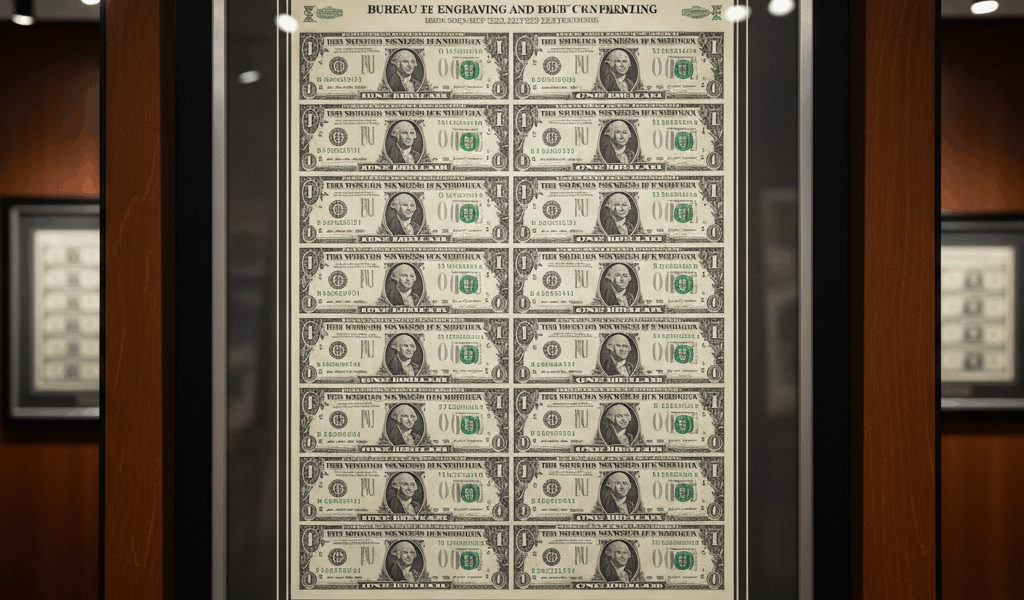
The Bureau of Engraving and Printing sells something remarkable: uncut sheets of real U.S. currency. These aren’t reproductions or souvenirs—they’re genuine legal tender that you can frame, collect, or theoretically cut apart and spend. Sheets of 32 connected dollar bills make dramatic displays while remaining official money.
What the BEP Sells
The Bureau of Engraving and Printing operates visitor centers in Washington, D.C. and Fort Worth, Texas where you can purchase uncut currency sheets directly. They also sell through their official website at moneyfactorystore.gov. Products range from 4-note sheets to massive 32-note sheets, covering $1, $2, $5, $10, $20, $50, and $100 denominations.
Prices include a premium over face value. A 32-note sheet of $1 bills (face value $32) sells for approximately $60. The premium covers printing, packaging, and handling costs while remaining reasonable for genuine uncut currency. Higher denominations cost more—a 4-note sheet of $100 bills runs around $500 for $400 face value.
Sheet Sizes Explained
Modern currency prints on large sheets that are cut into individual notes. The BEP sells sheets in several configurations based on the cutting process:
4-note sheets represent partial sheets cut from larger productions. These fit standard frames easily and make accessible gifts. The compact size limits visual impact but keeps prices reasonable.
8-note and 16-note sheets provide intermediate options. These balance display presence with manageability. They frame well using standard poster frames without custom requirements.
32-note sheets make the biggest impression. These complete currency sheets measure approximately 27 by 13 inches—substantial wall art that immediately captures attention. The regular grid of 32 identical notes creates striking visual patterns.
Special Editions and Premium Sheets
The BEP releases special sheets for commemorative occasions. Series launches, significant production milestones, and special events prompt limited editions with unique serial number ranges or packaging. These limited releases often appreciate after selling out.
Premium sheets feature specific serial number patterns. Low serial numbers, matching serial numbers across sheets, and fancy number combinations command higher prices. The BEP auctions especially desirable sheets, with competitive bidding sometimes pushing prices well above standard premiums.
Star replacement sheets occasionally become available. These contain star notes—currency printed to replace defective sheets—in uncut form. Star sheets represent genuine production artifacts while providing the visual appeal of connected notes.
Display and Framing
Proper display protects your investment while showcasing it. Currency-safe framing uses UV-protective glass or acrylic to prevent fading. Acid-free mats and backing prevent paper degradation. Quality framing costs roughly $100-200 for 32-note sheets but preserves value indefinitely.
Museum-quality framing takes additional precautions. Spacers prevent notes from touching glass directly. Conservation-grade materials ensure long-term stability. For valuable sheets or significant investments, professional framing from conservators provides maximum protection.
Alternative displays work for less formal settings. Quality poster frames with UV glass accommodate 32-note sheets at lower cost. Shadow boxes provide depth and three-dimensional presentation. Even unframed display using archival clips maintains collectibility while allowing future reframing.
Investment Considerations
Uncut sheets appreciate modestly over time. The BEP produces limited quantities for collector sales, and sheets from discontinued series become unavailable after sellout. Twenty-year-old sheets typically bring significant premiums over original purchase prices, particularly for higher denominations.
Condition preservation matters. Sheets stored properly in original packaging maintain premium values. Sheets exposed to light, humidity, or poor handling lose value regardless of denomination. The same sheet, properly stored versus poorly handled, might differ by 50% in value after two decades.
Special editions outperform standard sheets. Limited releases, significant serial numbers, and commemorative issues attract focused collector attention. These often sell out quickly and appreciate faster than standard production sheets.
Buying Smart
Purchase from official sources whenever possible. The BEP website and visitor centers sell at standard premiums with guaranteed authenticity. Secondary market purchases from established dealers provide alternatives for sold-out items but require careful authentication.
Beware counterfeits. Sophisticated fakes of uncut sheets have entered the market. These use genuine individual notes attached together or printed reproductions claiming to be original. Third-party authentication helps with secondary market purchases. Buying from the BEP directly eliminates these concerns.
Consider your purpose before purchasing. Gift giving suggests smaller, affordably framed 4-note sheets. Wall display favors impressive 32-note sheets properly framed. Investment focuses on special editions and higher denominations held in original packaging. Match your purchase to your actual intended use.
The Appeal of Uncut Currency
Uncut sheets represent a unique collecting category. They’re genuine legal tender, official government products, and dramatic visual displays. The novelty of real money in non-standard form attracts collectors who might not otherwise pursue paper currency.
Educational applications abound. Teachers use sheets to demonstrate currency production. Banks display them as conversation pieces. The connected notes illustrate printing processes invisible in individual bills.
As wall art, few objects combine uncut sheets’ unique qualities. They’re real money, officially sanctioned, visually striking, and modestly appreciating. Whether for collection, display, or gift giving, uncut currency sheets offer something that nothing else quite matches.

Stay in the loop
Get the latest bank note buzz updates delivered to your inbox.