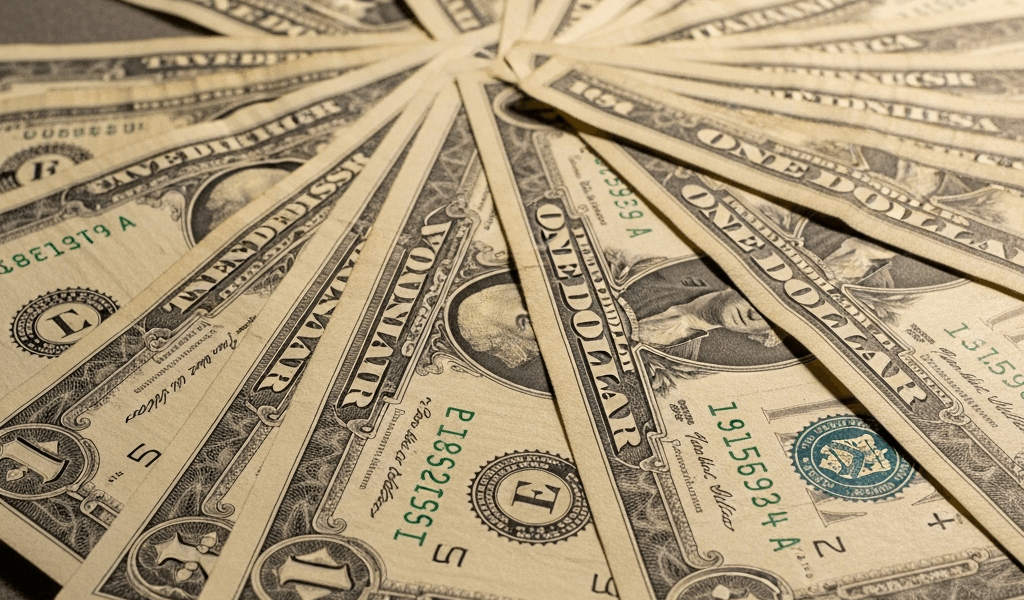
What Makes a 1934 Silver Certificate Valuable
1934 silver certificate pricing has gotten complicated with all the misinformation flying around. Dealers lowball. Sellers overprice. And most people in between have no idea what they’re actually holding. So today, I’ll share everything I know — which, after years of buying and selling paper currency, is apparently quite a lot.
But what is a 1934 silver certificate, really? In essence, it’s a paper dollar once redeemable for physical silver, issued by the U.S. government across five distinct printing runs. But it’s much more than that — each series letter stamped on the face tells a completely different story about rarity, survival rates, and what collectors will actually pay.
Four things drive value. The series letter — 1934, 1934A, 1934B, 1934C, or 1934D. Condition grade. Star note status. Serial number. Miss any one of these and you’ll price your note like someone who just found it in a shoebox. Which, honestly, might be exactly how you found it.
Condition separates the $10 bills from the $200 ones. I once figured my grandfather’s worn 1934A — stuffed between encyclopedia pages for roughly sixty years — was worth next to nothing. A dealer in Columbus offered $22 on the spot. That same note in Uncirculated condition? Closer to $120. Don’t make my mistake and assume age alone equals value.
Star notes carry a premium that surprises most first-timers. That small asterisk beside the serial number means the bill replaced a misprint during production — printed in far smaller quantities than standard runs. A 1934 star note in Very Fine condition pulls $45 to $65. The identical non-star version? $12 to $18. That one symbol is worth more than the rest of the bill combined.
1934 and 1934A Silver Certificate Values
The base 1934 and 1934A series dominate what most people encounter. You’ll find 1934A everywhere — the Bureau of Engraving and Printing ran longer production cycles on it, which pushed more notes into circulation and kept survival rates high. That abundance matters at the pricing table.
Here’s what you can expect by grade:
- Fine condition: 1934 runs $12–$18; 1934A runs $10–$15
- Very Fine: 1934 reaches $18–$28; 1934A sits $14–$22
- Extremely Fine: 1934 jumps to $28–$50; 1934A lands $22–$40
- Uncirculated: 1934 commands $50–$120; 1934A fetches $40–$95
Star notes are a different conversation entirely. A 1934 star in Fine condition sells for $35–$50. Very Fine pushes you into $55–$75 territory. Extremely Fine star notes climb to $85–$130. And Uncirculated 1934 stars? Heritage Auctions closed a pristine example at $575 last year — for a one-dollar bill.
1934A stars follow a slightly lower curve. They’re marginally more common than 1934 stars, though “more common” is relative — they’re still genuinely scarce. Very Fine 1934A stars typically move between $45–$65. Uncirculated examples land around $65–$110 for average serials, sometimes nudging higher depending on the collector pool that week.
Here’s the bottom line: a worn 1934A star beats a crisp non-star 1934 in value, every single time. Star status and condition outweigh series almost always — at least when comparing these two.
1934B, 1934C, and 1934D Silver Certificate Values
Probably should have opened with this section, honestly. These three series confuse new collectors constantly — they’re legitimately harder to find, yet most pricing guides either bury them three pages deep or skip them altogether.
| Series | Fine | Very Fine | Extremely Fine | Uncirculated |
|---|---|---|---|---|
| 1934B | $20–$32 | $32–$55 | $55–$90 | $90–$200 |
| 1934C | $18–$28 | $28–$48 | $48–$85 | $85–$170 |
| 1934D | $15–$25 | $25–$42 | $42–$75 | $75–$150 |
The 1934B had the shortest production run of all five series. In paper currency collecting, print numbers are everything — fewer bills printed means fewer surviving today in high grades. A worn 1934B will routinely outprice a crisp 1934A. Rarity offsets condition. That’s not theory; that’s what actually happens at auction tables.
Star notes amplify this gap considerably. A 1934B star in Very Fine reaches $65–$95. Uncirculated? Anywhere from $200 to $400 for average serials — and I’ve personally watched collectors ignore a stack of common Uncirculated notes to bid hard on a single scarce star example. The premium makes sense when you understand the survival numbers.
1934C and 1934D occupy the middle ground. 1934C stars in Uncirculated hover around $150–$300. 1934D stars are slightly more common but still pull $120–$280 in top condition. Neither approaches the ceiling of a 1934B star, yet both outpace their non-star counterparts by 300 to 500 percent — at least if you’re comparing equivalent grades. That’s what makes the star designation so endearing to us collectors. One small symbol rewrites the entire value conversation.
How to Grade Your 1934 Silver Certificate at Home
While you won’t need a microscope or professional lighting rig, you will need a handful of things — good natural light, a clean flat surface, and maybe a 5x loupe if you have one lying around. The $8 kind from Amazon works fine.
First, you should examine the front before anything else — at least if you want an accurate read on overall grade. Look for folds crossing the center or corners. Run your fingernail lightly along the edges. Crisp edges mean less handling. Soft or rounded edges tell a different story. Then study George Washington’s portrait closely. Individual hairs visible? Good sign. Slight blurring across the face? That’s circulation wear showing up.
Flip it over. The reverse eagle gets hammered by handling faster than almost anything else on the note. Deep creases through the wings, soft spots where the tail feathers lose definition, fading around the central shield — all of these signal a lower grade. I’m apparently more obsessive about reverse condition than most, and PMG grading has backed me up every time.
Fine condition means moderate overall wear — creases present but not deep, colors still reasonably bright, no tears or staining. Very Fine shows light wear, maybe one soft fold, ink still vibrant. Extremely Fine looks nearly new, with only faint handling marks and sharp detail throughout. Uncirculated means no folds, no corner softness, no aging whatsoever. Most 1934 notes that actually circulated in the 1930s won’t reach Uncirculated today. Simple math.
For anything valued above $100, send it to PMG or PCGS Currency for professional grading. A $15 to $22 grading submission fee on a $150 note adds real credibility — and slabbed notes sell faster and closer to full retail. Dealers trust the slab. They don’t trust your kitchen-table assessment. Neither should you, honestly.
Where Collectors Buy and Sell 1934 Silver Certificates
Three channels dominate this market: eBay completed sales for price research, Heritage Auctions for premium-grade material, and local coin dealers for fast cash.
eBay might be the best starting option, as 1934 silver certificate research requires real transaction data — not asking prices, not price guides, but actual completed sales. Search “1934 silver certificate,” filter strictly by sold listings, sort by highest price, and study what moved. Series letter, grade, serial number. You’ll identify pricing patterns within thirty minutes. A Fine 1934A star that closed at $48 last Tuesday tells you exactly where the market sits. Use completed sales as your floor, not your ceiling.
Heritage Auctions handles the serious end of the spectrum. Notes graded MS-65 or higher, star notes across all five series, fancy serials — repeaters, ladders, low numbers under A00000100 — and scarce 1934B or 1934C examples all perform strongly there. The commission runs 10 to 20 percent, depending on final sale price. Worth every dollar if your note is genuinely exceptional. Heritage pulls buyers with real money. eBay mostly doesn’t.
Local coin dealers buy for resale margins. Expect 60 to 75 percent of retail value walking out the door — a 1934A worth $50 retail nets you roughly $30 to $37 in immediate cash. That trade-off makes sense when speed matters more than squeezing full value. Visit at least three dealers before accepting any offer. I once got quotes of $28, $35, and $41 on the same note in the same afternoon. Same note. Three different dealers.
So, without further ado, here’s the practical breakdown: list mid-grade examples on eBay using the auction format, ten-day listings, and prompt shipping to reach the broadest collector base. Send premium pieces directly to Heritage Auctions. Take everything else to local dealers, compare three offers, and choose the highest. Speed or price — pick one. You probably can’t have both.


Stay in the loop
Get the latest bank note buzz updates delivered to your inbox.