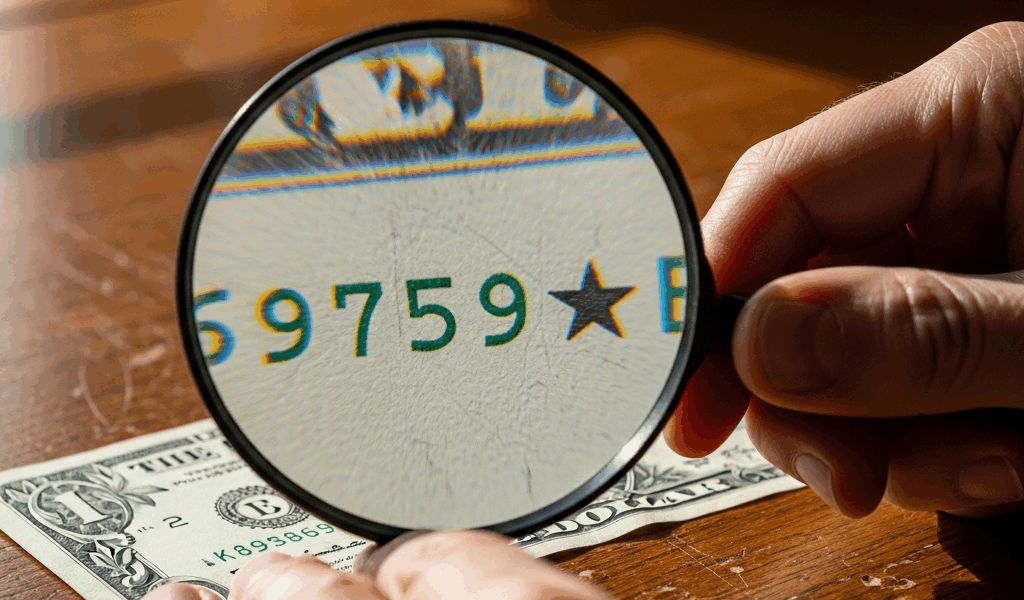
You just found a dollar bill with a tiny star next to the serial number, and now you’re staring at it wondering if this thing is worth more than a trip to the vending machine. Short answer: probably. The real question is how much more — and that depends on a few things most people don’t think to check.
Star notes are replacement bills. When the Bureau of Engraving and Printing’s presses spit out a defective note — bad ink, a miscut, whatever went wrong on the production line — they can’t just skip that serial number. So they print a replacement with a star symbol (★) tacked onto the serial number instead of the usual suffix letter. That star is basically the bill’s way of saying “I wasn’t supposed to be here.”
What Is a Star Note?
Every bill the Federal Reserve circulates has a unique serial number. When the BEP’s high-speed presses kick out a dud — smeared ink, a fold that got past inspection, a sheet that fed crooked — that serial number is burned. They can’t reuse it. The replacement note gets its own number with a star (★) printed where the suffix letter would normally go.
You’ll find star notes on every denomination from $1s all the way up to $100s. The star doesn’t change what the bill is worth at a register — a $20 star note still buys $20 worth of groceries — but it flags the bill as collectible. How collectible depends almost entirely on one variable: how many star notes the BEP printed in that particular run.
How to Identify Your Star Note
Flip the bill face-up and find the serial number. Modern Federal Reserve Notes have two serial numbers printed on the front — upper right, lower left. On a star note, the suffix letter at the end of the serial number is replaced by a small five-pointed star. Instead of seeing something like B 12345678 A, you’ll see B 12345678 ★.
Older notes — anything pre-1963 series — sometimes put the star at the beginning of the serial number. Either way, once you’ve seen one you won’t miss it. Same green ink as the rest of the serial, just a star where a letter should be.
Here’s what catches people off guard: that single letter before the serial number (like B for New York or L for San Francisco) is the Federal Reserve Bank district code, and it affects value. Some FRB districts produce far fewer star notes than others. I’ve seen two star notes from the same series where one district had a run of 3.2 million and another had a run of 64,000. Same bill. Wildly different collector interest.
What Makes a Star Note Rare (and Valuable)
Print run size. Full stop. The BEP actually publishes this data — how many star notes were printed for each series, denomination, and district. A star note from a 3.2-million-note run is about as special as a penny in a parking lot. One from a 3,200-note run is a different conversation entirely.
To put numbers on it: a $1 star note from a 640,000-note run in worn condition might bring $2 to $3 over face value. Same denomination from a 3,200-note run in similar shape? Easily $50 or more. The notes look identical sitting on a table. The difference lives entirely in the BEP’s production records.
Two other things move the needle beyond run size:
Denomination. Higher denominations carry bigger premiums partly because fewer people are willing to pull a $100 bill out of circulation on a hunch. The pool of preserved high-denomination star notes is just naturally smaller, and smaller supply means higher prices when a good one surfaces.
Where your note sits in the run. Serial number collectors pay a bump for notes at the very beginning or very end of a print run. A star note with serial 00000012 from a short run is basically a two-for-one collectible — rare star note plus low serial number.
Realistic Value Ranges by Condition
I’m going to be straight with you here because there’s a lot of hype floating around. Most star notes you’ll pull out of your wallet or grab from a bank strap are from large production runs. They’re fun to collect, but they’re not paying off your car loan. Here’s what the market actually looks like based on PMG auction data and Heritage Auctions results:
Circulated, common runs (VG to VF): $1 to $3 above face value. A $1 star note from a standard 3.2 million run in average shape goes for roughly $1.50 to $2.00 on eBay all day long. A circulated $20 star note from a big run? Maybe $22 to $25.
Uncirculated, common runs (AU to MS-63): $5 to $20 above face for $1 notes. Higher denominations scale up. An uncirculated $100 star note from a normal-sized run moves for $110 to $130 — nice, but not life-changing.
Scarce runs (under 320,000 printed), uncirculated: $25 to $100+. Now we’re getting somewhere. A $1 star note from a 64,000-note run grading MS-65 regularly hits $40 to $75 at auction.
Very rare runs (under 64,000 printed), gem uncirculated: $100 to $500+. This is the sweet spot that keeps star note hunters checking every bank strap. A 2017A $1 star note from the Dallas district — print run of just 3,200 notes — graded PMG 67 Superb Gem sold for over $300 at Heritage recently. Three hundred bucks for a dollar bill.
Bottom line: condition multiplied by run size determines value. Common run, average shape? Keep it in a sleeve for fun. Short run, crisp uncirculated? That’s worth your time to research properly.

How to Check Your Star Note Serial Number
You’ve got a star note sitting in front of you. Here’s the exact process to figure out what it might be worth — no guessing involved.
Step 1: Write down the full serial number and the series year. The series year is printed on the front of the bill near the portrait. Look for something like “Series 2017A” or “Series 2013.” Get it exactly right, including the suffix letter after the year — it matters.
Step 2: Find your Federal Reserve Bank district. That single letter before the serial number identifies which district printed your note. A = Boston, B = New York, C = Philadelphia, D = Cleveland, E = Richmond, F = Atlanta, G = Chicago, H = St. Louis, I = Minneapolis, J = Kansas City, K = Dallas, L = San Francisco.
Step 3: Look up the print run size. Head to the BEP’s production tables or use the MyCurrencyCollection Star Note Lookup tool. Plug in your denomination, series, and FRB district. The tool spits back the total print run for that exact combination. This number is everything — it tells you whether you’re holding a common replacement or something collectors are actually hunting for.
Step 4: Check what they’re actually selling for. Search eBay completed listings — and filter by “Sold,” not just listed. Listed prices are fantasy. Sold prices are reality. Match your series and district as closely as possible. PMG’s price guide works too for graded notes.
Step 5: Decide whether grading makes sense. Professional grading through PMG runs about $20 to $30 per note at the basic tier. If your note is uncirculated and from a run under 320,000, that investment usually pays off — a raw uncirculated note that sells for $30 might bring $60 to $80 in a PMG 65 holder. For circulated notes or common runs, grading typically costs more than the premium it adds. Save your money.
The star note market stays active because the BEP keeps releasing new production data. When a short run drops — anything under 100,000 notes — collectors notice fast. If you’ve got a star note from one of those small runs, especially in clean, uncirculated condition, it’s absolutely worth your time to look it up before spending it on a coffee.

Stay in the loop
Get the latest bank note buzz updates delivered to your inbox.