
As someone who started collecting US currency almost by accident — a few old bills from an estate sale sparked a curiosity that became a full-blown obsession — I learned everything there is to know about how our nation’s paper money evolved from colonial desperation to the complex system we use today. Today, I will share it all with you.
What I’ve discovered over years of collecting and researching is that American paper money tells the story of the nation itself. Every type of note — from revolutionary Continentals to Civil War greenbacks to the Federal Reserve Notes in your wallet right now — reflects the political circumstances, economic pressures, and national mood of the era that produced it. Once you start seeing currency through that lens, you can never look at an old bill the same way again.
Colonial Currency: America’s First Paper Money
The colonies faced a deeply practical problem: there simply weren’t enough coins to go around. Spanish dollars, British currency, and various foreign coins circulated in the colonies, but demand for money far outstripped the available supply. Paper money emerged as the solution, starting with Massachusetts way back in 1690.
The Experiment Begins
Massachusetts needed to pay soldiers returning from an expedition against French Canada. Rather than waiting for coins that didn’t exist and might never arrive, they printed paper bills promising future payment. It was desperate improvisation, but it worked well enough that other colonies quickly followed suit, each issuing their own currencies with varying degrees of fiscal responsibility.
Benjamin Franklin himself wrote extensively about the principles of sound currency management. Some colonies actually listened to advice like his and managed their paper money carefully. Others printed recklessly without any real backing or restraint. The results were entirely predictable — responsible colonies maintained the value of their notes while irresponsible ones inflated their currencies into virtual worthlessness. It’s a pattern that repeats throughout monetary history, honestly.
Problems and Lessons
Counterfeiting plagued colonial currency from the very beginning. The printing technology of the era was simple enough that skilled forgers could produce passable fakes with relatively basic equipment. Different colonies’ notes traded at wildly different values depending on how well that colony managed its money supply. British restrictions on colonial printing complicated matters even further.
Despite all the chaos and problems, though, the colonies proved something important: they could actually manage currency systems on their own. That capability and institutional knowledge would matter enormously after independence, when the brand-new nation needed its own money in a hurry.
Continental Currency and Revolutionary War Finance
The Continental Congress faced the classic revolutionary dilemma that has tripped up insurgent governments throughout history: how do you fund a massive war when you don’t have the power to levy taxes? Their answer — printing enormous quantities of paper money — worked at first but eventually failed in one of the most spectacular monetary collapses in history.
Initial Success and Ultimate Failure
Early Continental currency actually circulated at or near its face value. Patriotic Americans eagerly accepted the bills as a way to support the revolution with their wallets. But Congress kept printing. And printing. And printing some more. By 1779, cumulative issuance had blown past $200 million. Each individual note became worth less and less as millions more flooded into the economy.
The phrase “not worth a Continental” entered the American language and stuck there. By the time the war ended, Continental dollars were essentially worthless as purchasing power. This devastating experience with uncontrolled paper money created a lasting, deep-seated suspicion of government-issued currency that influenced American monetary policy for generations afterward. That suspicion echoes all the way through to modern debates about the Federal Reserve, if you listen for it.
Collecting Continentals Today
Despite their total economic failure, Continental notes fascinate currency collectors today, and I’m one of them. These are tangible pieces of revolutionary history, printed during the most uncertain years of the nation’s existence. Holding a Continental is holding a piece of the Revolution itself. Prices range from a few hundred dollars for common issues in rough shape to several thousand for scarcer denominations in better condition. They’re more accessible than many collectors think.
The Early Republic: Bank Notes and Confusion
The Constitution gave Congress the power to coin money but conspicuously did not say anything explicit about paper currency. For decades, the federal government basically stayed out of the paper money business entirely, leaving note issuance to hundreds of individual state-chartered banks scattered across the growing nation.
The result? Absolute confusion. Notes from one bank might be completely worthless fifty miles away. Merchants had to keep reference publications called “bank note reporters” that listed which banks’ notes were currently good and which had failed. Conducting basic commerce required constant vigilance against notes from failed banks and skillfully produced counterfeits. It’s almost hard to imagine doing business under those conditions, but millions of Americans managed it somehow for decades.
The Civil War Transforms Everything
The Civil War forced fundamental, permanent changes to how American money worked. The federal government finally entered the paper money business for real, and this time it wasn’t leaving.
Demand Notes and Greenbacks
In 1861, the Treasury issued Demand Notes — the first federal paper money since the Continental disaster generations earlier. Printed with distinctive green ink on the reverse, they earned the nickname “greenbacks” that we still use casually today. Legal Tender Notes followed in 1862, authorized by Congress for payment of debts but not backed by any gold or silver reserves. It was a bold move born of desperation, and this time it worked far better than the Continental experiment.
National Bank Notes
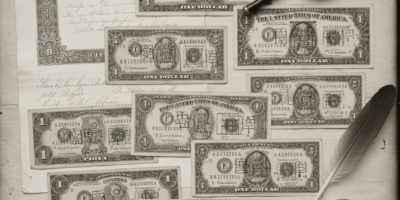
The National Banking Acts of the 1860s created a new system of nationally chartered banks that could issue standardized notes backed by government bonds. Over 14,000 different banks eventually participated in this program across the entire country. Notes from rare banks — especially tiny small-town institutions that issued very few notes before closing their doors — command enormous premiums from collectors today. I’ve seen notes from obscure banks sell for five figures at auction. The combination of local history and scarcity makes them irresistible to certain collectors.
Confederate Currency
The Confederacy issued its own currency to fund its side of the war, and that currency inflated dramatically as the conflict dragged on, eventually becoming entirely worthless after Union victory. Confederate notes are widely collected today by people fascinated by this era. Common issues can be found for under $50, making them an accessible entry point for anyone interested in Civil War history. Scarcer types in good condition bring substantially more, and the most desirable pieces can sell for thousands.
Gold and Silver Certificates
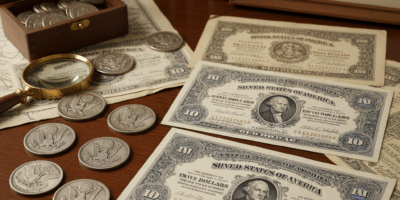
Starting in 1863, the Treasury began issuing certificates that directly represented gold or silver held in government vaults. You could literally take one of these notes to the Treasury and exchange it for the precious metal it represented. These notes offered the convenience of paper money while maintaining the reassuring backing of physical commodities.
Gold Certificates, recognizable by their distinctive orange seals, circulated from 1863 to 1933. When FDR took America off the gold standard, even possessing them became temporarily illegal for private citizens. That dramatic history makes surviving examples especially interesting and desirable as collectibles.
Silver Certificates, with their blue seals, circulated from 1878 all the way to 1964. Most people of a certain age remember seeing them — the blue seal on otherwise normal-looking dollar bills. Common examples are readily available and quite affordable, making them a popular starting point for new collectors dipping their toes into the hobby.
Federal Reserve Notes: Today’s Currency
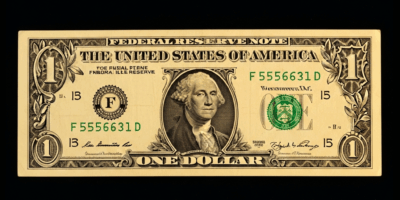
The Federal Reserve Act of 1913 created the system we still use today. Federal Reserve Notes, issued by twelve regional Federal Reserve Banks spread across the country, gradually became the dominant form of paper currency, eventually displacing all the other note types that had coexisted for decades.
In 1929, the Treasury reduced currency to the smaller dimensions we’re all familiar with today, saving significant amounts on paper and printing costs. All note types switched to the new size simultaneously. The transition-era notes from both the larger and smaller size eras are widely collected, and having an example of each makes for a fascinating side-by-side comparison of American monetary history.
Building Historical Context
Currency collecting gains incredible depth when you understand the economic and political circumstances surrounding each issue. A Legal Tender Note means so much more when you know it helped finance the Civil War. A National Bank Note from some tiny Kansas town you’ve never heard of suddenly connects you to the story of westward expansion and the building of a continental nation.
The story of American paper money is, at its core, the story of America itself — its wars, its financial crises, its heated political debates, and its progress through centuries of change. Each note is a genuine primary source from that ongoing history. That direct connection to the past, that ability to hold history in your hands, is what makes currency collecting meaningful far beyond whatever any individual note might be worth in dollars and cents.

Stay in the loop
Get the latest bank note buzz updates delivered to your inbox.