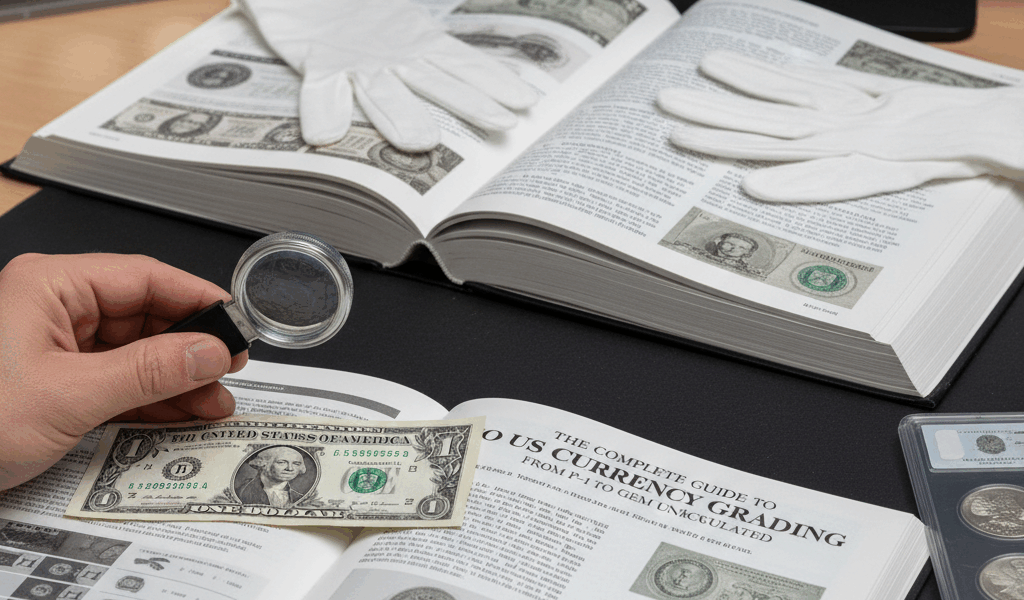
Paper money grading confuses most new collectors. The terminology sounds arcane, the price differences between grades seem arbitrary, and two notes that look identical to untrained eyes might differ by thousands of dollars in value. This guide breaks down the American grading system used by major third-party graders like PMG and PCGS Currency, explaining what each grade means and how to evaluate notes yourself.
Why Grading Matters
A 1928 $20 Gold Certificate in Good condition might sell for $150. The same note in Gem Uncirculated commands $3,000 or more. Understanding grading helps you buy accurately, sell fairly, and build a collection with real value.
Grading isn’t purely subjective. Professional graders follow established standards developed over decades. While reasonable people can disagree on borderline cases, the major grades represent distinct condition levels that most experienced collectors can identify.
The Sheldon Scale
Paper money uses a modified version of the Sheldon Scale, originally developed for coins. The scale runs from 1 to 70, though paper money practically never grades below 4 or above 70. Here’s what the numbers mean.
Poor (P-1) to Fair (Fr-2)
Notes in these conditions are barely identifiable. Major pieces missing, heavy damage, possibly torn in half and taped back together. Only the rarest notes have any value at these grades. Most common notes at P-1 or Fr-2 are worth face value or less—essentially just paper.
About Good (AG-3)
The note is complete but heavily worn. The design is visible but details are largely gone. Heavy soiling, major creases, and significant handling marks. Edges may be rough or torn. For common notes, still essentially worthless to collectors. Rare notes might have modest value.
Good (G-4 to G-6)
Now we’re entering collectible territory for scarcer notes. The design is clearly visible. Major elements like portraits and vignettes show, though fine details are worn away. The note has been heavily circulated—expect numerous folds, some soiling, and soft, rounded corners.
A G-4 note typically shows heavier wear than G-6. The difference matters for pricing rare notes but less so for common ones.
Very Good (VG-8 to VG-10)
The note shows heavy circulation but retains more detail than Good. You can make out secondary design elements. Creases are prominent but haven’t broken the paper. Some remaining crispness exists, though the note is clearly well-used.
Many collectors start here for type notes—one example of each design variety rather than condition-chasing a single series.
Fine (F-12 to F-15)
A Fine note has seen real circulation but still looks presentable. Details are worn but largely complete. Multiple folds visible, some soiling likely, but the paper remains intact without tears or missing pieces. Colors have faded somewhat but remain identifiable.
F-12 shows heavier wear; F-15 approaches the next grade level. For expensive notes, these distinctions affect pricing significantly.
Very Fine (VF-20 to VF-35)
The sweet spot for many collectors. A VF note shows moderate circulation—several folds, some handling marks, perhaps light soiling—but retains strong visual appeal. Details are clear. Colors remain reasonably bright. The note looks good in an album or display.
Within Very Fine, the spread matters:
- VF-20: Lower end, more wear visible, numerous folds
- VF-25: Solid middle ground
- VF-30: Strong for the grade, approaching Extremely Fine
- VF-35: Choice VF, minimal wear for a circulated note
Extremely Fine (EF-40 to EF-45)
Light circulation only. A few folds—typically three or fewer significant creases. Some handling marks but no heavy soiling. The note retains much of its original crispness. Colors bright. Details sharp.
EF notes often look nearly uncirculated to casual observers. The trained eye spots the light center fold or the subtle softness where the note was handled repeatedly.
About Uncirculated (AU-50 to AU-58)
These notes were barely circulated. Perhaps passed hand to hand a few times, maybe carried in a wallet briefly. You might find a single light fold or some evidence of counting marks from bank handling.
AU notes retain virtually all original crispness and color. The distinction between AU-50 and AU-58 comes down to trace wear—the higher numbers showing less evidence of handling.
AU-58 represents the ceiling for circulated notes. One grade higher enters Uncirculated territory.
Uncirculated (UNC-60 to UNC-63)
No fold lines. No circulation wear. The note went from the printing press to storage without passing through commerce. However, lower Uncirculated grades show handling marks—counting crimps, slight bends, minor issues that prevent a higher grade.
A UNC-60 note is technically uncirculated but has significant handling evidence. UNC-63 shows fewer issues but still falls short of Choice.
Choice Uncirculated (UNC-64)
A strong uncirculated note with good eye appeal. Minor handling marks might exist but don’t distract. Centering is decent though not perfect. Colors are bright. A very respectable grade for most collections.
Gem Uncirculated (UNC-65 to UNC-66)
Exceptional notes with minimal flaws. Strong centering, bright original colors, crisp paper, no distracting handling marks. These notes stand out even among other uncirculated examples.
Most collectors building a quality type set aim for Gem Uncirculated when budget allows. The jump from Choice (64) to Gem (65) often doubles or triples the price.
Superb Gem (UNC-67 to UNC-68)
Premium quality. Near-perfect centering, exceptional paper quality, flawless surfaces. These notes represent the top tier of commonly available uncirculated specimens.
Price premiums here become substantial. A note worth $500 in 65 might command $1,500 in 67.
Perfect Uncirculated (UNC-69 to UNC-70)
Theoretical perfection. A 70-graded note has no flaws whatsoever—perfect centering, perfect margins, perfect color, perfect paper. In practice, 70s are almost never assigned to older notes. Even modern notes rarely achieve this grade.
Notes graded 69 exist but are uncommon. Most collectors never pursue these grades due to extreme rarity and cost.
EPQ, PPQ, and Other Designations
Beyond the numeric grade, third-party graders add qualifiers for exceptional paper quality.
PMG’s EPQ (Exceptional Paper Quality)
PMG assigns EPQ to notes with original, unaltered paper quality. No cleaning, pressing, restoration, or other treatments that might artificially enhance appearance. EPQ notes typically command 10-30% premiums over non-EPQ equivalents.
PCGS Currency’s PPQ (Premium Paper Quality)
The PCGS equivalent to EPQ. Same concept—original, untreated paper. The two designations are functionally identical in the marketplace.
Star Designations
Some grading services add stars to indicate exceptional eye appeal beyond what the numeric grade suggests. A “66 Star” note might have the visual impact of a typical 67.
Factors That Determine Grade
Professional graders evaluate multiple factors when assigning grades.
Folds and Creases
The primary determinant for circulated notes. Each fold reduces the grade. A single hard center fold typically drops an otherwise pristine note to AU or below. Multiple folds progressively lower the grade.
Fold severity matters. A light crease differs from a hard, paper-breaking fold. Some creases “come out” over time as the paper relaxes; others remain permanent.
Centering
How well the printed design sits within the margins. Perfect centering means equal margins on all sides. Poor centering—the design shifted toward one edge—lowers grades, especially for Uncirculated notes.
Centering standards have evolved. Early notes were hand-cut with variable margins. Modern notes should be well-centered; those that aren’t face grade penalties.
Color and Brightness
Original, unfaded colors increase grades. Washed-out, faded, or oxidized notes grade lower. Some fading is expected for heavily circulated notes, but brightness affects grades at all levels.
Paper Quality
Beyond EPQ designations, paper quality affects the numeric grade. Thin spots, pinholes, tears, missing pieces, stains, and other paper defects lower grades. Notes with major paper problems may be designated “net graded”—the number reflects what the note would grade without the problem.
Eye Appeal
The subjective element. Two notes with identical technical characteristics might receive different grades based on overall visual impression. A note that “looks great” for its grade might push upward; one that looks tired might drop.
Grading Your Own Notes
Learning to grade takes practice. Here’s how to develop the skill.
Handle Notes Carefully
Use clean, dry hands or cotton gloves. Hold notes by the edges. Work over a soft surface. Poor handling damages notes and makes accurate grading impossible.
Use Proper Lighting
Examine notes under consistent, neutral lighting. Natural daylight or LED bulbs work well. Avoid fluorescent lights, which can mask or exaggerate certain characteristics.
Check for Folds Systematically
Hold the note at an angle to the light. Rotate it. Folds cast subtle shadows. Check horizontally, vertically, and along the diagonals. Count the folds you find.
Examine the Paper
Look for thin spots, tears, pinholes, or stains. Turn the note over—problems sometimes show more clearly from the back. Check the edges for splits or roughness.
Assess Centering
Measure margins if needed. Compare the design position to known well-centered examples. Online references and certified note images help establish benchmarks.
Compare to Known Grades
Study notes with certified grades. Major auction houses publish detailed images of graded notes. Build a mental library of what each grade looks like.
When to Use Third-Party Grading
Professional grading makes sense for valuable notes where the grade significantly affects price. The cost and time investment doesn’t justify grading common notes worth less than $100.
Benefits of Third-Party Grading
- Objective assessment from trained professionals
- Authentication catches counterfeits and alterations
- Protective holder prevents further damage
- Easier resale with trusted grade
Drawbacks
- Cost: $25-150+ per note depending on service level
- Time: Weeks to months for standard submissions
- The grade might disappoint expectations
Most collectors submit selectively—their best notes for protection and authentication, leaving common material raw.
Building Skills Over Time
Grading accuracy improves with experience. Attend coin shows and examine graded notes in person. Join collecting clubs where members share knowledge. Study auction catalogs with high-quality images. Over time, you’ll develop the eye that distinguishes a VF-25 from a VF-30 at a glance.
The investment in learning pays off. Accurate self-grading helps you buy better, price your notes fairly, and understand the market that drives our hobby.

Stay in the loop
Get the latest bank note buzz updates delivered to your inbox.