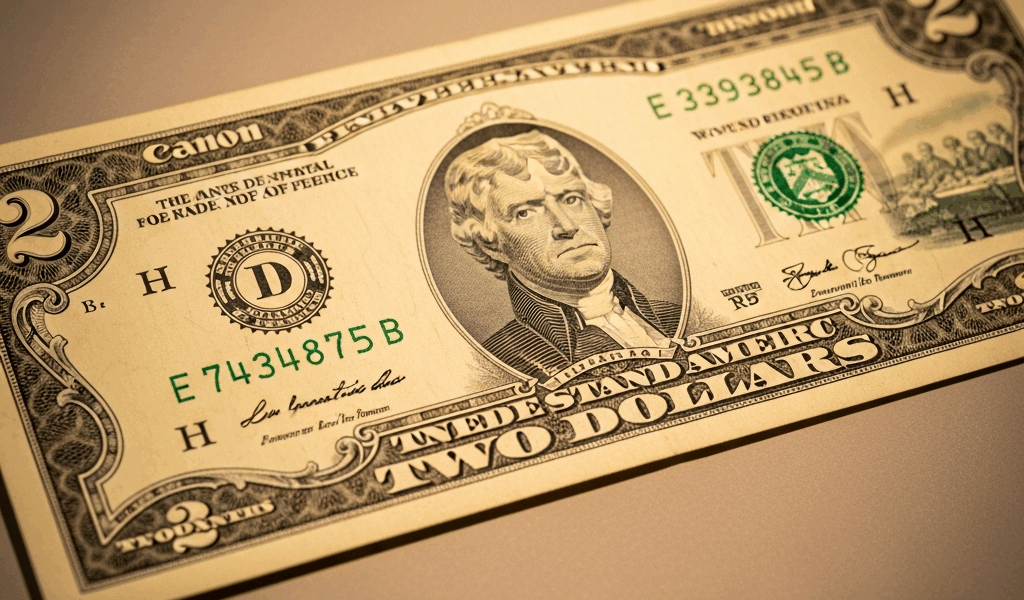
Are 1976 Two Dollar Bills Actually Worth Anything?
Two dollar bill values have gotten complicated with all the misinformation flying around. As someone who’s spent years buying and selling currency at shows, flea markets, and Heritage Auctions, I learned everything there is to know about the 1976 bicentennial note. Today, I will share it all with you.
Here’s the short answer first: most circulated examples are worth face value plus maybe a dollar or two. Not five hundred dollars. Not even fifty. I get asked about these constantly — at least twice a week, someone finds one in grandma’s desk drawer and thinks they’ve hit a windfall.
But what is a star note? In essence, it’s a replacement bill marked with an asterisk. But it’s much more than that — it’s the single biggest factor separating a $3 bill from a $185 auction result. Condition and first-day cancellations round out the picture. All three matter. Most bills have none of them.
The Bureau of Engraving and Printing ran these off in massive quantities for the bicentennial. Massive. That alone explains why millions of Americans have one sitting in a junk drawer right now. The scarcity myth collapses the moment you see the actual print run numbers.
Value by Condition — What Dealers and Collectors Actually Pay
Probably should have opened with this section, honestly. Most people have no real framework for what “condition” means in currency collecting. So here are real numbers — pulled from eBay sold listings, Heritage Auctions results, and dealer conversations at shows.
Circulated (Average to Fine): $2 to $4. This is a bill that lived in someone’s wallet. Folded, maybe coffee-stained, possibly written on. These move at roughly the speed of regular currency.
Fine to Very Fine: $4 to $12. Handling shows, but no major damage. Light folds. No tears. Color still decent. Dealers will pay this range if you walk in with a clean stack.
Extremely Fine (XF): $12 to $35. Looks almost new. Maybe one or two faint folds visible under direct light. No writing. No stains. Corners still sharp. Uncertified XF notes land consistently in this range on eBay.
Uncirculated (MS-60 to MS-63): $25 to $60. Crisp. Flat. Original sheen intact. PMG or PCGS graded examples command the higher end. Raw, unslabbed notes sit closer to $25 to $35 — buyers can’t trust an unverified grade, so they discount it.
Gem Uncirculated (MS-65 and higher): $60 to $150+. Museum quality. Certified by PMG or PCGS. No handling marks under magnification. Genuinely rare for a 1976 note because almost nobody stored these correctly.
The raw-versus-graded gap is real and it’s significant. A raw MS-63 might fetch $30. That same note in a PMG MS-63 holder? $60 to $75. Buyers pay for authentication and the resale confidence a slab provides. That’s what makes grading endearing to serious collectors in this hobby.
Star Notes and Why They’re Worth More
An asterisk before or after the serial number means you’re holding a star note — a replacement bill. Somewhere on the production line, a misprinted note got pulled, and this one took its place. Smaller production run. Higher collector demand. Simple math.
Here’s where it gets district-specific. The 1976 $2 star notes weren’t all printed in equal numbers across Federal Reserve districts. Dallas, Minneapolis, and Kansas City ran low. A circulated Dallas star note might bring $8 to $15. A New York star note in identical condition? $4 to $6. The Bureau of Engraving and Printing publishes print run data publicly — look up your district code before assuming anything.
The premium gap is striking once you see it. A regular uncirculated 1976 $2 bill sells for $25 to $40. An uncirculated star note from Dallas or Kansas City? $80 to $200, depending on grade. I’ve watched PMG MS-65 Dallas Fed star notes close at $185 to $210 at auction. Don’t make my mistake of assuming all stars are created equal — district matters enormously.
I’m apparently wired to check serial numbers obsessively, and that habit works for me while ignoring district codes never does. Check yours. If there’s an asterisk, write down the district code embedded in the serial number. Cross-reference it online. If it’s Dallas, Kansas City, or Minneapolis and the note looks pristine, get it graded. Seriously.
First Day Issue Cancellations and Postmarked Bills
April 13, 1976. That was the date. The U.S. Post Office offered special first-day cancellations for the bicentennial $2 bill, and plenty of people deliberately mailed their notes to get that postmark. It became its own legitimate niche inside numismatics.
Key word: legitimate. A genuine cancellation is clean, centered, applied by a postal machine — not smudged, not scrawled with a pen, not covering the portrait or serial number. Crisp ink. Mechanical precision. You can tell the difference immediately once you’ve seen a real one next to a fake.
A pristine bill with a clean April 13, 1976 cancellation sells for $15 to $40 depending on how centered the stamp landed and how crisp the note is underneath it. Creased bill, smudged cancellation? $5 to $12. Someone who wrote on the bill before mailing it thinking the postmark would salvage the value? It didn’t. It just added two kinds of damage instead of one.
These are niche collectibles — more so than uncirculated star notes. The postmark premium is real but modest. The bill still has to be in excellent shape underneath it, or the whole equation falls apart. So, without further ado, let’s talk about whether yours is worth grading.
How to Know If Your 1976 Two Dollar Bill Is Worth Grading
PMG and PCGS charge $15 to $25 per note at their lowest submission tier. That covers authentication, a numeric grade, and a protective slab that boosts resale appeal. It’s not cheap for a low-value note.
The math only works one way — the bill has to be worth more graded than it costs to grade it. A circulated regular 1976 $2 bill? Don’t grade it. You’ll spend $20 to add maybe $3 of value. Sell it raw to a dealer or list it on eBay for $3 to $5 and call it done.
PMG might be the best option for uncirculated star notes, as currency certification requires trusted third-party verification. That is because serious auction bidders won’t pay premium prices for unverified grades — the slab removes doubt and unlocks competitive bidding. I’ve seen the same note jump $40 in value just by being in a holder.
While you won’t need a full numismatist’s library, you will need a handful of resources — a loupe or magnifier, the BEP’s print run data, and ideally a currency dealer’s eyes before you commit to grading fees. Most dealers at coin shows will assess a note for free. Use that.
First, you should examine the note under direct light — at least if you want an honest read on condition. Look for folds along the horizontal center crease. Check corners. Hold it at an angle and look for handling marks. If it’s flat, crisp, with original paper sheen intact, you might have something worth pursuing.
For selling: eBay moves circulated regular notes fastest — $2 to $5, minimal effort. Coin shops and currency dealers at shows pay slightly less but buy instantly, no shipping, no waiting. Heritage Auctions is the right venue for PMG or PCGS certified premium notes. That’s where the serious collectors with real budgets show up.
Your 1976 $2 bill is probably worth $2 to $5. It could be worth more — check that serial number for a star, assess the condition honestly, figure out the district. If you’ve got something genuinely crisp and special, get it in front of someone who knows currency. If it’s a folded, circulated regular note, enjoy it as a neat piece of bicentennial history and don’t lose sleep over it.

Stay in the loop
Get the latest bank note buzz updates delivered to your inbox.