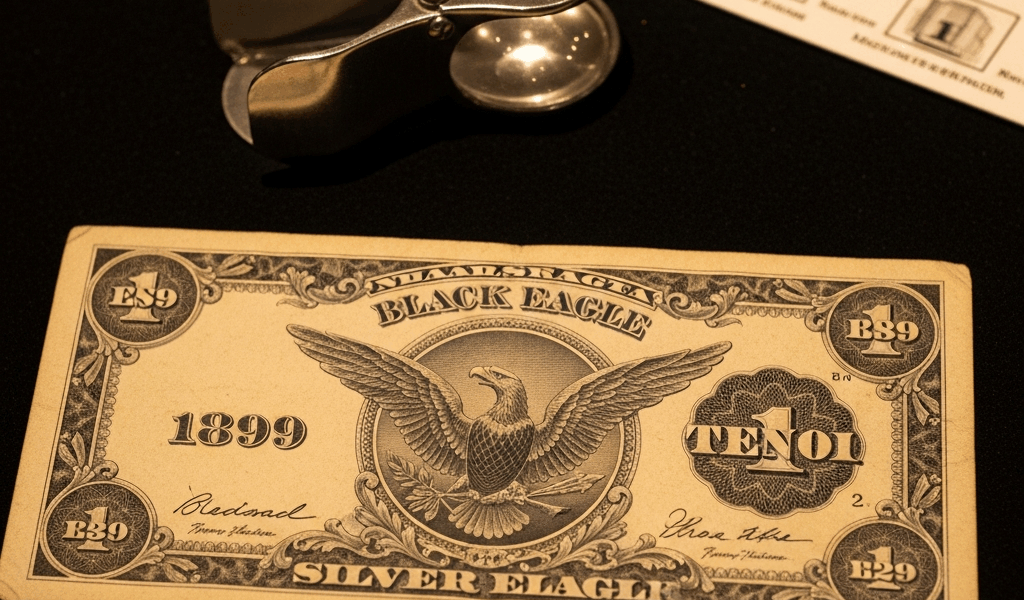
What Makes the 1899 Black Eagle Stand Out
Collecting large-size silver certificates has gotten complicated with all the misinformation flying around about values, grades, and which notes are actually worth pursuing. As someone who has spent years studying these notes firsthand — handling them, buying them, watching them sell at auction — I learned everything there is to know about the 1899 Black Eagle. Today, I will share it all with you.
But what is the 1899 Black Eagle? In essence, it’s a large-size $1 silver certificate featuring a bald eagle dominating the face, wings stretched wide across the U.S. Capitol building in almost obsessive engraving detail. But it’s much more than that. Flip one over and you’re looking at two portrait vignettes — Abraham Lincoln on the left, Ulysses S. Grant on the right. The engraving precision on these notes makes modern Federal Reserve currency look lazy by comparison. That’s not an exaggeration. That’s just what happens when you compare 1899 craftsmanship to today’s offset printing.
Why do collectors hunt these down? Simple. Scarce enough to feel like an actual find, common enough that you won’t need a second mortgage to own one. The 1899 Black Eagle represents the absolute peak of American large-size silver certificate design — well past the awkward early 1870s attempts and well before the stripped-down 1923 redesign flattened everything out. At roughly 7.4 by 3.1 inches, these notes have physical presence. A $1 note that commands genuine respect sitting in a holder. That’s rare. That’s what makes the 1899 Black Eagle endearing to us collectors.
Value by Signature Combination and Grade
Probably should have opened with this section, honestly. Most people searching for a 1899 Black Eagle value guide want numbers, not a history lesson. Here’s the thing that trips up newer collectors: the same note in identical condition sells for wildly different prices depending on who signed it. The U.S. Treasury issued eleven distinct signature combinations across this series. Some are everywhere. Some disappear fast at auction.
So, without further ado, let’s dive in.
The Signature Pairs and Their Market Reality
Lyons-Roberts is your baseline — the most common pairing you’ll encounter. Buying raw and ungraded, expect to pay:
- Good: $40–$65
- Fine: $90–$140
- Very Fine: $220–$380
- Uncirculated: $650–$1,100
Lyons-Treat moves into slightly rarer territory — figure 15 to 20% more across the board. Roughly $50–$75 in Good, pushing toward $800–$1,400 in Uncirculated. Vernon-Treat sits in the same neighborhood. Maybe $60–$80 Good, $750–$1,500 Uncirculated. Close enough that condition and centering matter more than the signature difference at these levels.
Vernon-McClung is where things get genuinely interesting. Noticeably scarcer. Good condition starts around $85–$120. Very Fine specimens jump to $400–$650. An Uncirculated example will run $1,200–$2,000 — because Vernon-McClung notes weren’t printed in anywhere near the quantities of Lyons-Roberts. The math is simple. Fewer printed, fewer survived.
Napier-McClung follows a similar pattern — $80–$110 in Good, $350–$600 in Very Fine, $1,000–$1,800 in Uncirculated. Napier-Thompson and Parker-Burke are rarer still. Parker-Burke examples in Very Fine condition sell for $500–$800. Uncirculated Parker-Burke notes can hit $2,000–$3,000. I’ve watched these move at Heritage Auctions specifically — they disappear the moment they’re crisp and well-centered. Don’t blink.
Teehee-Burke, Elliott-Burke, Elliott-White, and Speelman-White occupy the premium end of this spectrum. Teehee-Burke is genuinely scarce. Good examples fetch $150–$250. Very Fine notes run $600–$1,000. Uncirculated? Somewhere between $2,500 and $4,500 isn’t unreasonable — and I’ve seen strong examples push past that ceiling at the right auction. Elliott-White and Speelman-White are the rarest pairs in the series. Uncirculated Speelman-White examples have sold above $5,000 at major houses. That number keeps climbing.
These figures reflect raw sales and dealer asking prices as of 2024. PCGS and PMG graded specimens command premiums — typically 20 to 40% over raw equivalents at VF or better, sometimes considerably more for the scarcer signatures in high grades.
How Condition Affects What You Actually Get Paid
Understanding grade categories separates collectors who make smart buying decisions from people who overpay or undersell their own notes. Large-size currency is fragile by nature — folded, stuffed in wallets, passed through hands that had no interest in preserving engraving detail.
Good condition means the note is recognizable and legally complete. Heavy folds. Probably some staining. Maybe edge wear soft enough to blur design elements slightly. Pinholes might show up. The note works as a collectible but isn’t pretending to be anything more. Honestly, Good-grade notes are where value starts becoming real — you’re paying enough that condition matters, but not so much that a small crease tanks the price significantly.
Fine means fewer folds, less staining. The note circulated but somebody treated it with slightly more care than their grocery list. Edges hold up better. Design reads clearly. Eye appeal starts here. Fine-grade 1899 Black Eagles are genuinely sweet spots for budget collectors — visible improvement in appearance without the jump into Very Fine premiums.
Very Fine is where the note begins to look like someone actually cared about it. Light folds only — nothing heavy, nothing crossing through the central design. No staining worth mentioning. The eagle pops. These command real money because they’re desirable and harder to find than people expect. A VF example is the first tier where serious collectors think “yes, I want this in my collection.”
Uncirculated means essentially never spent. No folds. Original paper luster still visible. Maybe some light handling at the corners or a barely perceptible bend — but the note never made a transaction. These are the examples that hit five figures when rare signatures align with strong grades.
Raw versus slabbed is the practical divider most sellers mishandle. A raw note is what you hold in your hand. A slabbed note is what you send to PCGS or PMG — they authenticate it, grade it, seal it in a plastic holder with a label. Collectors trust third-party grades in a way they simply don’t trust dealer descriptions. A raw VF note from an unfamiliar source carries uncertainty. That same note in a PMG VF-30 slab carries standardized authentication. Dealers and auction houses price slabbed notes higher — sometimes substantially higher. If your raw note grades VF or better, submitting before selling almost always justifies the $15–$25 submission fee. Good or Fine notes? Sell raw. Grading costs eat margins on lower-grade material, and buyers at those price points aren’t demanding slabs anyway.
Star Notes and Mule Notes — Are They Worth More
Star notes were replacement currency — printed when a production run produced errors, with a star symbol appearing in the serial number to distinguish them from standard issues. These are genuinely rare. Sometimes only a few thousand printed against millions of standard examples from the same run.
A 1899 Black Eagle star note commands a 50 to 150% premium depending on the signature pair. Lyons-Roberts stars run roughly $75–$120 in Good versus $40–$65 for standard. The premium widens considerably in higher grades — a star note Uncirculated can hit $2,000 or more when standard Uncirculated examples sell for $800–$1,100. Rarer signature stars are a different world entirely. Speelman-White stars have sold above $8,000. I’m apparently someone who gets personally annoyed watching these sell for less than they’re worth at local shows, and Heritage works for me while eBay listings for star notes never quite capture what they should.
Mule plate combinations — where face and back were printed using mismatched plate numbers — exist in this series but are genuinely obscure. Most collectors ignore them entirely. They don’t move premiums unless you’re selling to a specialist chasing plate variety completeness. Not worth overthinking unless the note checks all those boxes already.
If you own a 1899 Black Eagle and the serial number contains a star, investigate immediately. You might be sitting on a 30 to 40% value bump — minimum. Don’t make my mistake of assuming the star was decorative the first time I encountered one. It wasn’t.
Where to Buy or Sell a 1899 Black Eagle
Heritage Auctions runs the most consistent 1899 Black Eagle inventory of any house I’ve tracked. Their online catalog lets you filter by signature combination, grade, and realized price — invaluable for seeing what actually sold versus what dealers were hoping to get. Stack’s Bowers holds regular currency sessions with strong large-size silver certificate representation. Both houses bring the audience reach and authentication expertise that matters when something worth four figures is on the block.
eBay sold listings are free research — full stop. Filter strictly by “sold” rather than “asking” and you’ll see real transaction prices without dealer markup inflating your expectations. Local currency shows and dealer tables remain underrated venues. Face-to-face prices typically land below online retail but above raw auction closing bids. The flexibility to hold the note before buying matters more than people admit.
Selling strategy: VF or better means PCGS or PMG slabbing pays for itself before you even list it. Submit to Heritage or Stack’s rather than going raw on eBay — you’ll reach the right buyer and capture the premium the slab deserves. Good or Fine? Dealer sale or eBay raw makes sense. Grading costs eat profit margins on lower-grade material fast.
Buying strategy: know the signature pair before you start hunting. Set your budget and grade threshold before you fall in love with a note above it. Lyons-Roberts is forgiving — decent examples under $300 exist if you’re patient. Rare signatures require patience and available cash, full stop. Track realized prices for ninety days before committing to anything significant. The market moves, but not wildly — you’ll develop solid intuition faster than you’d expect. First, you should set a ninety-day price-tracking window — at least if you want to buy with confidence rather than hope.


Stay in the loop
Get the latest bank note buzz updates delivered to your inbox.